
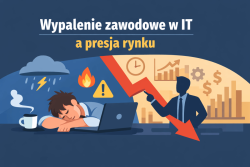
Overwork, constant stress, and exhaustion are everyday realities for many IT professionals in today’s market conditions.
The IT industry is widely seen as a dream sector—high salaries, prestige, flexible hours. Yet behind this façade lies a growing problem of occupational burnout. Recent studies show that nearly 75% of IT professionals experience symptoms of burnout, even though they declare satisfaction with their job and pay. Burnout is no longer an individual incident but a widespread global phenomenon, which is confirmed by its inclusion by the WHO in the ICD-11 classification as an occupational syndrome. The technology sector is particularly vulnerable—according to a Mercer report, over 80% of employees worldwide feel at risk of burnout, and IT ranks among the most heavily burdened industries. Despite this, only about one third of employers fully recognize the seriousness of the problem.
The phenomenon has been intensified by the pandemic and rapid changes in the labor market. Although COVID-19 has subsided, the IT industry continues to feel its aftereffects: first, the massive shift to remote work, and more recently, waves of layoffs, combined with the need to keep pace with the technological revolution (e.g., AI). This combination of factors has created a state of extreme exhaustion among IT workers. In the article below, we examine the causes of burnout in the context of market pressure, its consequences for individuals and organizations, and present ways to prevent this phenomenon—from actions at the individual level to company-wide initiatives.
Causes of Burnout in IT Constant Technological Change and Development Pressure
Technology in IT evolves at a lightning-fast pace. Every few months, new programming languages, libraries, or tools emerge, and professionals are expected to keep up. For developers, this means a constant need to learn—the learning curve practically never ends. Even experienced specialists often feel that their knowledge becomes outdated quickly, which can lead to frustration and impostor syndrome (the belief that one is insufficiently competent despite objective achievements). The constantly upgrading technological world pushes many people to study after hours just to “stay current,” which over time drains energy and joy from the job.
A particularly strong stress catalyst recently has been artificial intelligence. The popularization of AI forces upskilling—or even reskilling into entirely new roles—and many IT workers feel pressure to master AI-related competencies that were not previously part of their job scope. Constantly “chasing” trends leads to fatigue and uncertainty. Paradoxically, tools meant to improve efficiency often complicate work at first—77% of IT professionals admitted that implementing AI tools increased their day-to-day workload rather than reducing it. There is also fear about keeping up with change—or even being replaced by automation. Such continuous pressure to develop and learn is a straight path to burnout, especially when there is no time to rest.
Employer Expectations and an Overtime Culture
Employment in IT is often associated with high expectations from managers and clients. Technology companies operate at a fast project-driven pace, which frequently means overtime and working under tight deadlines. Working significantly longer than the standard eight-hour day and remaining in a prolonged state of “constant readiness” to respond are factors that contribute to burnout. More than half of IT specialists admit they are overwhelmed by daily tasks and lack the time to meet all expectations in a normal work mode. While management acknowledges that performance demands have increased, in practice it is employees who bear the brunt—65% openly say they struggle to keep up with their supervisors’ expectations.
Work culture in the industry can be unforgiving: in many organizations, there is an unspoken assumption that one must be constantly available and respond immediately to issues. For example, DevOps engineers and system administrators often perform 24/7 on-call duties, which blurs the boundary between work and private life. Developers also feel pressure to deliver new features quickly—even at the cost of working extra hours after work. When combined with staff shortages (e.g., cybersecurity teams being chronically overloaded) and the awareness that any mistake can have serious consequences (financial, legal, reputational), the result is a recipe for chronic stress. Unfortunately, some companies still fail to counteract a workaholic culture—only 32% of business leaders declare that caring for employees’ mental health is more important to them than investing in new technologies (such as AI). This means that in many firms, productivity is prioritized over employee well-being, creating fertile ground for burnout.
Remote Work — Benefits and Drawbacks
The mass shift to remote work during the pandemic brought both benefits and new challenges for IT professionals. On one hand, the lack of exhausting commutes and greater flexibility improved work–life balance for many specialists—73% of respondents cited better work–life balance as a key advantage of working from home. On the other hand, remote work often blurs the line between working time and rest. Many people struggle to “agree” on the end of the workday when the company laptop is always within reach. The workday extends unnoticed, and the feeling of being constantly at work promotes fatigue.
Isolation from the team is another factor—one in five remote workers complains about loneliness and lack of contact with colleagues. The absence of direct interaction can increase stress and reduce motivation. Additionally, there is the phenomenon of hidden overtime: remote employees often feel pressure to be constantly available online, since their physical presence is not visible. According to research, 38% of employees experience burnout related to remote work due to pressure to work longer hours, and as many as 86% of remote workers report high levels of fatigue and exhaustion. If an organization does not establish clear rules and support for distributed teams, home office—rather than comfort—may result in deteriorating well-being and reduced effectiveness.
Industry Instability and Fear of Layoffs
In recent years, job insecurity has added to the pressure in IT. After a long period of technological boom, sudden workforce reductions occurred in global corporations. The technology sector alone accounted for roughly one third of the 700,000 layoffs in the United States in 2022–2023—companies such as Google, Meta, and Microsoft cut between 6% and 13% of their workforce in 2023. These mass layoffs shook the sense of security among IT employees worldwide. In companies that underwent restructuring, remaining staff often experience survivor’s guilt: alongside relief at keeping their jobs comes stress and guilt that colleagues were laid off. Worse still, the responsibilities of those who were dismissed do not disappear—they are shifted onto the shoulders of those who remain, enforcing the rule of “more work with a smaller team.” Managers often expect performance levels to be maintained despite reduced resources, which is why 38% of technology workers report working even longer hours after layoffs, while only a few experienced any workload relief. This atmosphere of constant layoff anxiety and overload strongly contributes to burnout—people live in fear of losing their jobs while simultaneously having to “deliver results” for themselves and their missing colleagues.
Different Roles, Different Burdens
Different IT roles struggle with different sources of stress:
Developers: Constant technological evolution requires continuous learning, and projects often change mid-stream. One of the most demotivating experiences is the feeling of wasted effort—weeks of work on a feature may be discarded when a project changes direction or code is rejected. Additionally, working with complex, inherited legacy code generates frustration and the sense that more time is spent fighting system flaws than creating real value.
Administrators / DevOps: They are on the front line of system maintenance, often in a constant state of readiness. A “24/7” work culture causes the boundary between work and private life to disappear. Managing extensive infrastructure and multiple tools (from cloud platforms to CI/CD pipelines) requires frequent context switching, which reduces productivity and increases cognitive load, ultimately leading to fatigue.
Cybersecurity Specialists: They operate under constant pressure, as any mistake can have catastrophic consequences. A daily reality is so-called alert fatigue—a flood of hundreds of alerts (mostly false positives) that must be analyzed. Continuous vigilance and prolonged “fight-or-flight” mode are psychologically exhausting in the long run. Due to the global shortage of cybersecurity experts, teams are often overloaded, and each specialist must cover a very broad range of responsibilities.
Project Managers: They must reconcile conflicting interests—those of the team, the client, and the business—and often run several projects simultaneously. More than half of PMs manage two to five projects at once, which generates enormous stress and burnout risk. Each project carries high responsibility with limited control over resources or changing requirements. Constant firefighting, decision-making under pressure, and absorbing stakeholders’ frustrations lead many PMs to experience decision fatigue and emotional exhaustion.
Testers (QA): Their work takes place at the end of the software development cycle and therefore often suffers from time shortages—delays in development drastically reduce the time available for testing. Testers are frequently undervalued, as long as everything works, their contribution remains invisible. However, when a defect reaches production, QA is blamed. This toxic mix of high pressure, great responsibility, and low recognition makes burnout in this role common.
Analysts (business, system, data): Those involved in requirements and data analysis face constant change and uncertainty. A business analyst must reconcile client needs with IT team capabilities—when requirements change repeatedly, frustration and pressure increase. They often work under tight deadlines, delivering analyses or reports needed for business decisions. Errors or delays at the analysis stage can lead to serious project issues, for which the analyst may be held accountable. Data analysts, in turn, grapple with vast volumes of information and expectations of fast, accurate insights—under tight deadlines, this also fosters fatigue and a strong sense of responsibility for potential mistakes.
The Consequences of Burnout — From the Individual to the Organization Individual Consequences (for the Employee)
Occupational burnout is a syndrome resulting from chronic workplace stress that has not been successfully managed—this is how the WHO defines it. It manifests in three key dimensions: exhaustion, cynicism (depersonalization), and reduced professional efficacy. The employee experiences physical and emotional fatigue and lacks energy even after rest. A negative, detached attitude toward work emerges—tasks that were once engaging no longer bring satisfaction; indifference or irritability dominates, sometimes even hostility toward duties and coworkers. Finally, a burned-out person develops a sense of ineffectiveness and lack of accomplishment—they devalue their achievements, feel incompetent, and lose faith in the purpose of their work.
Typical warning signs include chronic fatigue, lack of job satisfaction, deteriorating relationships with coworkers, and a noticeable decline in performance. These are often accompanied by psychosomatic symptoms such as tension headaches, sleep problems, persistent nervous tension, and low mood. In studies, employees affected by burnout reported, among other things, headaches (42%), chronic fatigue (38%), insomnia (35%), and anxiety-depressive symptoms (32%). Burnout may also involve a loss of engagement—the employee does the bare minimum just to get through the day. Increased use of sick leave (an “escape into illness”) is common, as is social withdrawal or outbursts of anger toward loved ones outside of work. In other words, burnout devastates both the professional and private life of the affected individual.
Organizational Consequences (for the Company)
Burnout among IT employees affects not only individuals but also organizations. Reduced engagement and motivation translate directly into lower productivity across teams. A burned-out employee is more frequently absent (sick leave, last-minute leave), less effective, makes more mistakes, and shows less initiative. Entire teams may suffer from a decline in the quality of products and services, with increased risk of failures or missed project deadlines. In an atmosphere of cynicism and exhaustion, creativity and innovation decline—employees stop proposing improvements and focus solely on surviving the workday.
Worse still, burnout can be contagious—the frustration and negative attitude of one person can spread to colleagues, especially when overload affects many team members. Companies struggling with this issue also observe higher turnover. Employees who feel burned out are more likely to consider leaving or actually submit their resignation. Research shows that one in three employees is considering leaving their job within the next six months specifically due to burnout and excessive workload. An experienced IT specialist is extremely valuable—losing one is a major blow to a company. Replacing them generates high costs (recruitment, onboarding) and risks the loss of knowledge and project continuity.
It is also worth noting that mass layoffs and restructurings can amplify hidden costs in the form of reduced morale among “survivors.” Studies indicate that employees who remain after layoffs experience a whole cocktail of negative emotions—from anger and fear to guilt—which results in lower productivity and creativity, increased absenteeism, and a greater desire to leave the company. In short, workforce burnout leads to tangible business losses: lower quality, loss of talent, recruitment difficulties (due to poor employer reputation), and reduced market competitiveness. Conversely, employers who actively counteract burnout and care for team well-being reap clear business benefits—as shown in a Microsoft report, companies that invest in employee engagement during difficult times can achieve up to twice the financial performance of those that do not.
How to Prevent Burnout — Actions at the Employee, Team, and Company Levels
At the employee level:
Setting boundaries and balance: Consciously separate work time from personal time. Avoid blurring these boundaries—for example, do not routinely respond to work emails after hours, and allow yourself genuine daily rest. Although as many as 70% of developers admit to coding as a hobby on weekends, such practices hinder full mental and physical recovery. Make sure that periods of intense work are followed by time to breathe—the world will not collapse if you disconnect from your laptop and work phone for the evening.
Managing workload and time: Practice techniques that help prevent overwhelm. Break large projects into smaller steps, take regular breaks (e.g., the Pomodoro method), and try to limit multitasking, which reduces efficiency. Avoid constant task switching—focusing on one task at a time increases productivity and reduces cognitive fatigue. Learn to let go as well—not everything must be perfect right now.
Recognizing warning signs and seeking support: Do not ignore the early signs of burnout (such as constant irritability, sleep problems, declining energy, or loss of motivation). Instead of “gritting your teeth,” talk to someone you trust—a manager, mentor, or colleague. Together you can look for solutions (e.g., changing priorities or delegating part of your workload). Seeking professional help is not a reason for shame—talking to a psychologist or coach can provide perspective and teach stress-management techniques. It is a sign of maturity, not weakness. More and more companies offer free therapy consultations or support hotlines—use them before the problem escalates.
Healthy lifestyle and development outside work: Remember that body and mind are connected. Adequate sleep, regular physical activity, a healthy diet, and hobbies unrelated to IT can do wonders for mental resilience. Even with a packed schedule, find time for a walk, the gym, or simply playing with your children—this is not a luxury but an investment in your performance. Also take care of personal development in line with your own pace: learn new things on your terms, and if you feel stuck, talk to your manager about a development plan or a project change to regain professional enthusiasm.
At the team level:
Trust-based atmosphere and open communication: Managers and team leaders should build a culture where employees are not afraid to talk about problems. Key here is psychological safety—the belief that team members can openly admit workload overload or mistakes without fear of punishment. Regular one-on-one meetings, anonymous mood surveys, and project retrospectives are tools that help detect burnout symptoms before they spiral out of control. It is crucial that reported issues are met with understanding and action, not dismissal.
Leadership by example: Team leaders must model healthy behaviors—if a manager sends emails at midnight and never takes vacation, they signal that the same is expected of others. A good manager respects employees’ private time: does not require online presence after hours, takes breaks and vacations themselves, and encourages the team to rest. Normalizing work–life balance (e.g., praising effectiveness rather than late-night work) helps people leave on time without guilt. When leaders show that goals can be achieved without constant self-sacrifice, others are more likely to follow.
Fair workload distribution and autonomy: Teams need fair task allocation, so no one consistently carries the heaviest burden. It is important to monitor whether someone is taking on too much (frequent overtime can be a signal) and respond by redistributing tasks if necessary. Maintaining a balance between responsibility and control is equally important—if an employee is accountable for a critical area, they should be given appropriate decision-making autonomy and trust. IT professionals are often frustrated when they have a lot of responsibility but no influence (e.g., a tester responsible for quality but with no say in the project schedule). Give people real freedom in how they execute tasks—this fosters agency rather than helplessness. Regular feedback and development conversations help correct imbalances before they turn into frustration.
Collaboration and mutual support: A team should function like a unit—cultivate good relationships and a supportive atmosphere so everyone feels they can rely on colleagues. Simple rituals, such as a shared coffee break (even virtual in remote teams) or a weekly recap highlighting achievements, help build connection. When workload is heavy, encourage knowledge sharing and mutual assistance—developers can support testers by writing automated tests, seniors can take over some tasks from juniors, etc. Avoid a “hero culture,” where the same person repeatedly saves projects at the expense of their own health. Recognition of every team member’s contribution (not just those on the front line) boosts motivation—praising a tester or system administrator for well-done work builds a sense of value and prevents feelings of being overlooked.
At the organizational (company) level:
Employee well-being as a priority: The organization should treat mental health and employee satisfaction as equal to business results. In practice, this means HR strategies focused on well-being—from support programs (e.g., anonymous psychological helplines, access to therapy) to proactive education policies (stress-management workshops, ergonomics training, promotion of work–life balance). In Poland, more and more companies are recognizing this—prestigious rankings such as Top Employers 2024 highlight organizations for whom well-being is a key management principle. For example, one IT company offers employees access to coaches and consultations with specialists (psychologists, dietitians, physiotherapists) as part of preventive healthcare. Such initiatives build a culture where asking for help is normal, and employees feel treated as individuals.
A healthy approach to working time: Counteracting an overtime culture should be an official company policy. A good step is encouraging the use of vacation (e.g., reminding employees about unused leave) and—crucially—not disturbing employees during time off with work matters. Some organizations introduce no-email policies after hours or establish communication “quiet hours” after 6 p.m. Flexible work arrangements also help—occasional remote work, flexible start times, or additional days off (sabbaticals, “mental health days”) give employees space for personal matters and recovery, which later translates into productivity.
Learning and development during working hours: Continuous learning is intrinsic to IT work, but companies can ensure it does not come solely at the expense of employees’ private lives. Employers should create conditions for learning within working hours—for example, dedicating part of the schedule to training, innovation projects, or experimentation. Google, for instance, adopted the principle that in a 40-hour workweek, engineers can spend around 8 hours (20%) on skill development or personal projects. Other companies invest in e-learning platforms and internal knowledge libraries. This approach pays off: on one hand, it raises team competencies; on the other, it reduces stress related to having to learn after hours. Employees see that the company supports their development and do not have to chase new trends at night on their own.
Process and tool optimization: Technology should be an ally, not an additional source of frustration. Organizations should regularly improve work processes—eliminate unnecessary bureaucracy, automate repetitive tasks, and invest in tools that increase efficiency (e.g., better ticketing systems, monitoring, automated testing). With new trends such as AI, implementations should aim to reduce employee workload, not merely raise targets. For example, bots and scripts can take over tedious tasks (network monitoring, basic testing) and free up time for creative work. As many as 94% of IT employees say they would gladly hand over simple, repetitive tasks to AI to focus on more important projects. This shows technology’s potential to reduce workload—provided it is implemented thoughtfully and accompanied by proper training. (If AI upskilling becomes just an additional duty without removing other tasks, it will have the opposite effect.)
Monitoring and rapid response: Companies—especially large ones—should have early warning systems for burnout. Regular employee satisfaction surveys, such as engagement questionnaires, can signal declining enthusiasm or overload within teams. Line managers should be trained to recognize burnout symptoms among their reports (irritability, declining work quality, withdrawal, increased absenteeism) and how to respond—through supportive conversations, temporary workload reduction, or offering professional help. It is also crucial to destigmatize the topic at the organizational level: talking openly about balance, sharing stories (e.g., a manager describing their own crisis and recovery) gives employees permission to take care of themselves.
A culture of appreciation and respect: Preventing burnout relies heavily on a sense of meaning and recognition at work. Companies should not only demand results but also acknowledge achievements—praise contributions, reward teams after challenging projects, and celebrate successes. Promoting values such as balance, trust, and collaboration instead of toxic competition or a culture of constant availability is equally important. When employees see that the company treats them as its most valuable asset rather than disposable resources, they respond with greater loyalty and engagement. This, in turn, translates into tangible business benefits—higher productivity, lower turnover, and stronger financial performance in a competitive global market.
Burnout in IT is a signal that existing work models have reached their limits and that a change in approach is necessary. Market pressure will not disappear—competition, technological progress, and demanding clients will always be part of the industry. However, how organizations and IT professionals respond to this pressure depends on the actions they take. Caring for mental health is not a cost but an investment—in the most important resource of the technology sector: human talent, creativity, and passion for building things. By fostering a culture of balance, support, and continuous learning, IT companies can not only protect their employees from burnout but also strengthen innovation and achieve sustainable success in the ever-changing global market.