
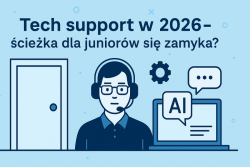
For years, technical support (helpdesk, service desk, IT support) was the “front door” to the IT industry. In 2026, that door still exists—but the hinges are clearly creaking. On the one hand, companies are automating first-line support with chatbots and AI assistants; on the other, demand is growing for more competent, independent specialists who can work with AI, not alongside it.
So the real question is no longer just whether the junior path is closing, but rather: for which juniors—and what new doors should they be looking for?
1. Tech Support as a Classic Entry Path – What Has Changed
-
The traditional first-line IT support model was based on simple tasks:
-
resetting passwords, unlocking accounts,
-
basic troubleshooting of networks, printers, VPNs,
-
clicking tickets through to higher support tiers,
-
user contact based on ready-made scripts.
This was a natural starting point for graduates of universities, courses, or even high school students with strong language skills. In Poland, many shared service centers (SSC/BPO) built their IT support teams precisely on juniors with English or German.
After the pandemic boom and the 2020–2022 “eldorado,” the market has clearly cooled. The 2024 No Fluff Jobs report shows that while the number of IT job postings has stabilized, competition per role has increased—to an average of 44 applications per posting, more than a year earlier. In other words, candidates are plentiful, and employers can be selective.
At the same time, the share of classic developer roles and simple technical positions in total postings is shrinking, while categories related to security, data, and AI are growing. This is an important signal: there are fewer “easy” entry points into IT, and the competency bar is higher.
2. 2023–2025: A Global Junior Crisis, Not Just in Support
This trend is not limited to Poland. Data from the U.S. and European markets shows that:
globally, after the record year of 2022, the tech sector began reducing headcount—especially in less specialized roles,
analyses cited in articles on AI’s impact on the labor market indicate that in 2023–2024, some of the eliminated jobs were junior positions in development, data analysis, and IT support,
according to Stack Overflow analyses, entry-level IT hiring fell by around 25% year over year in 2024, and many lower-level roles are “within reach of automation,”
other studies even point to double-digit declines in employment among young workers in roles heavily affected by AI.
In parallel, the World Economic Forum, in its Future of Jobs report, shows that around 40% of employers plan to reduce headcount where tasks can be automated by AI, while simultaneously creating new roles higher up the value chain (analytics, AI, data).
For juniors, this leads to a simple but painful conclusion: the market is tightening at the bottom of the career ladder more than in the middle or at the top.
3. What AI Is Doing in Tech Support Today: Practice, Not Theory
IT support automation is no longer a vendor slide—it’s everyday reality in many companies. Several elements are key:
3.1. Chatbots and Virtual Agents
Modern ITSM (Service Desk) systems use:
-
virtual support agents that can:
-
reset passwords,
-
initiate software updates,
-
trigger procedures such as “install package X on computer Y,”
-
first-line bots that intercept repetitive, simple tickets before they reach a human.
This is exactly the area where junior helpdesk specialists traditionally “learned the trade.”
3.2. Automated Routing and Escalation
AI increasingly:
-
classifies tickets by content,
-
assigns them to the right queue and person,
-
suggests solutions based on knowledge bases and ticket history,
-
reduces unnecessary escalations.
In practice: instead of five juniors “clicking through” tickets, one more experienced specialist plus a well-configured system is enough.
3.3. Proactive, Predictive Support
In IT service and infrastructure maintenance, there is a shift toward:
-
remote monitoring and proactive problem detection,
-
AI-based predictive maintenance,
-
hybrid models combining remote support with limited on-site visits.
Automation is therefore consuming not only simple end-user support, but also part of the work of a typical “junior admin” who used to manually check logs, temperatures, and alerts.
4. The Polish Perspective 2025–2026: Growth, but Uneven
On the Polish IT market, two parallel stories are unfolding:
Mild rebound and stabilization – labor market reports show:
-
a stable number of postings in 2024 (only a slight year-over-year drop),
-
growth in job ads in Q4 2024,
-
continued recovery in 2025, driven by more projects in AI, data, and security.
A clear gap between juniors and mid/seniors – analyses for the 2025/2026 transition indicate that while IT job postings in Poland grew by about 12% year over year:
-
companies are more willing to hire experienced specialists,
-
juniors struggle to enter the market unless they have strong, practical skills.
Forecasts for 2026 explicitly warn that simple first-line technical support roles may be partially taken over by chatbots and AI assistants, reducing demand for juniors.
This does not mean the end of IT support as such, but it does mean:
-
classic “printer-and-password” helpdesks will hire less,
-
more specialized roles will grow: business application support, cloud support, security, SRE, complex infrastructure operations.
5. Is the Junior Path Closing? A Less Obvious Answer Than You Think
The conclusions from global and Polish research can be summarized as follows:
The path for “juniors doing simple tasks” is closing – that is, people who:
-
only know “basic Windows,”
-
don’t understand the broader context of networking, security, or cloud,
-
can’t work with automation tools and AI.
These tasks can largely be automated, and companies have no reason to maintain large teams of juniors just to reset passwords.
Demand remains (and is even growing) for “Juniors 2.0” – people who:
-
handle user communication well, linguistically and socially,
-
have a technical understanding of systems, networks, and cloud basics,
-
can use AI as a tool (diagnostics, log analysis, procedure generation),
-
learn quickly and move toward second-line support, DevOps, security, or cloud.
Gartner forecasts that by 2030, about 75% of IT tasks will be performed by humans supported by AI, and only 25% fully by machines; importantly, by 2026 the net impact of AI on IT job numbers is expected to be roughly neutral, with a positive balance emerging only after 2028.
This points to a restructuring of roles, not mass disappearance of all support jobs.
The path is narrower, but steeper – fewer roles at the lowest level, but faster transitions into concrete specializations for those who prepare well.
In short: the door isn’t closed—but knocking with nothing more than “basic computer skills” is no longer enough.
6. What a “Junior in Tech Support” Looks Like in 2026
If your goal is to start in IT support in 2026, job descriptions increasingly include:
6.1. Scope of Responsibilities
-
handling tickets in ITSM tools (Jira Service Management, ServiceNow, Freshservice, etc.),
-
working with knowledge bases and AI tools that suggest solutions,
-
solving simpler but already technically concrete issues:
-
VPN, MFA, SSO,
-
basic networking topics (DNS, DHCP, routing),
-
support for SaaS applications (Microsoft 365, Google Workspace, CRM, ERP),
-
initial analysis of logs and monitoring alerts,
-
documenting and automating repetitive tasks (scripts, playbooks).
6.2. Expected Skills
Job ads increasingly list requirements such as:
fluent foreign language skills (English plus, for example, German or French),
basic knowledge of:
-
operating systems (Windows, Linux),
-
networking (OSI model, TCP/IP basics),
-
directory services (Active Directory, Azure AD),
-
cloud platforms (Microsoft 365, Azure, AWS),
-
initial experience with ticketing, monitoring, cybersecurity,
-
ability to use AI tools in daily work (copilots, chats, virtual agents).
-
In other words, the “junior of 2026” is effectively what a solid semi-junior or junior-mid was in 2018–2019.
7. How to Prepare for Tech Support in 2026 – A Practical Plan
If you still want to enter IT through tech support, it makes sense to treat it not as “any job in IT,” but as a starting point toward a specific specialization.
7.1. Choose Your Direction from the Start
Common development paths include:
-
Cloud & DevOps – from first-line user support to infrastructure, automation, CI/CD.
-
SecOps / cybersecurity – from handling user incidents to security incident response, SOC.
-
Business applications – specialization in a specific system (ERP, CRM, e-commerce, SaaS).
-
SRE / systems reliability – from ticket handling to monitoring, reliability, and performance.
A conscious choice helps you, even as a junior, to:
-
select relevant projects (e.g., cloud environment support rather than purely “office helpdesk”),
-
build a portfolio of tasks you can later “sell” in your CV.
7.2. Build a Technical Foundation – Not Just “Computer Use”
A minimum that truly makes a difference:
-
a home/lab environment with:
-
virtual machines (Linux + Windows),
-
a simple domain (e.g., Samba, AD), VLANs, VPN,
-
monitoring (Zabbix, Prometheus—even a basic setup),
-
solid networking fundamentals: TCP/IP, DNS, DHCP, NAT, VPN,
-
understanding of security principles (MFA, least privilege, basic hardening).
These don’t need to be enterprise-grade, but they show that you’re not someone hired solely to answer phones.
7.3. Learn to Work with AI Instead of Fearing It
Given the rapid growth of job ads requiring AI skills in Europe (in some countries, listings mentioning GenAI have more than doubled year over year), ignoring this trend is asking for trouble.
In practice:
-
use AI to:
-
generate playbooks and procedures,
-
translate logs into “human language,”
-
create knowledge base articles,
-
learn prompting in an IT context (error diagnosis, automation design),
-
test virtual agents and chatbots—you’ll be working with them, and sometimes configuring them.
Companies implementing AI in service desks emphasize that AI boosts the productivity of less experienced employees the most, shortening onboarding time. That’s a major opportunity for juniors who already come equipped with “AI literacy.”
7.4. Add Certifications and Proof of Practice
When entering support roles, “classic” certifications still matter:
-
CompTIA A+ / Network+,
-
ITIL Foundation,
-
basic Microsoft certifications (Microsoft 365, Azure Fundamentals),
-
online courses in system administration, security, cloud.
The point isn’t collecting certificates, but documenting that you’ve actually worked through practical topics—which shortens the recruiter’s path from “bootcamp junior #2617” to “someone worth giving a chance.”
8. Alternatives to the Classic Helpdesk as a First Job
If competition for typical helpdesk roles starts to feel like a lottery, consider alternative entry paths:
Application Support – supporting a specific product/SaaS, often closer to business analysis than “printers.”
QA / manual testing with a path to automation – manual testing is also under automation pressure, but combined with automated testing skills it can be a solid entry point.
Customer-facing tech roles – Customer Success or Technical Account Manager positions in product companies, where both soft and technical skills matter.
Low-code / no-code and process automation – building simple automations (Power Automate, Zapier, Make, RPA tools) can be just as valuable today as reinstalling Windows.
These paths share one advantage: they often bypass the most crowded “junior helpdesk in a corporation” corridor while still leading toward roles with greater responsibility and better prospects.
9. Conclusions: Tech Support in 2026 Isn’t a Closed Door—Just a Higher Threshold
Let’s return to the title question: “Tech support in 2026—Is the junior path closing?”
Yes—for those who think “I like computers” and Excel skills are enough. Simple, repetitive first-line tasks are natural automation targets. Companies won’t hire juniors en masse for work that chatbots or virtual agents can do faster and cheaper.
No—for those who treat support as a deliberate, technical start toward a specific specialization. IT support in 2026 is more technical, closer to cloud, security, and monitoring—and tightly integrated with AI tools. For people willing to invest in skills and go beyond “password resets,” it remains a viable, though more demanding, entry path into IT.
You could say that the path isn’t closing—it’s narrowing and climbing higher. The question is no longer “will you get in,” but “are you ready to step onto a higher rung right from the start?”