
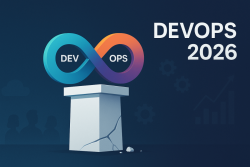
DevOps has spent the past decade rising to the status of an IT “superhero”: everything depended on it—whether a product could be deployed, maintained, monitored, and rescued when things started to burn. No wonder the DevOps Engineer position was one of the most sought-after roles worldwide in 2024, and the adoption of DevOps practices reached, according to various estimates, 70–80% of tech companies.
At the same time, by 2024–2025, more and more voices began talking about the “death of DevOps” and the rise of a new king: platform engineering, SRE, or “cloud platform teams.” Will DevOps really fall from its pedestal in 2026—also in the job market? Is this a real shift, or simply a game of labels and semantics?
1. Where did DevOps’ pedestal come from in the first place?
DevOps emerged as an answer to several pain points of traditional IT:
separate dev and ops silos,
long release cycles,
manual deployments,
lack of end-to-end ownership of the product.
A combination of culture (“you build it, you run it”) and automation (CI/CD, IaC, monitoring, containerization) quickly delivered tangible benefits: shorter time-to-market, fewer failures, and more predictability.
Market data confirms this:
the global DevOps tools and services market is expected to grow from around USD 10.4 billion in 2023 to USD 25.5 billion in 2028 (CAGR ~19.7%),
in Europe, the DevOps market is estimated at around USD 11.5 billion in 2024, forecast to exceed USD 45 billion by 2032 (CAGR ~18–19%),
74–80% of organizations report implementing some form of DevOps, with most stating it brought positive impact.
Against this backdrop, DevOps Engineer became one of the top most in-demand technical roles globally.
In Poland, DevOps has become a key specialization—particularly in banking, telecom, e-commerce, and software houses. IT job market reports consistently list DevOps Engineers among the most sought-after professionals, and senior salaries often reach 25–30k PLN gross (employment contract) or higher on B2B.
This is the very “pedestal” DevOps is supposedly about to fall from.
2. What is changing by 2026? Three forces shifting the landscape
DevOps is not disappearing by 2026. What’s changing is the context in which the role operates:
2.1. Market saturation and organizational maturity
Large companies and enterprises already have CI/CD, monitoring, IaC, and cloud in place—now the focus is less on “introducing DevOps,” and more on optimization, standardization, and scaling.
A team of “2–3 DevOps engineers doing everything” no longer fits the reality of dozens of microservices, multicloud setups, and multiple product teams.
There is growing need for building internal platforms, not just “more pipelines.”
2.2. Cost pressure and cloud maturity
Companies—also in Poland—are increasingly focused on:
cloud costs (FinOps),
infrastructure standardization,
security and compliance by design.
This shifts the focus away from generalists who “know everything about AWS/Azure/Kubernetes” toward more structured roles: platform teams, SRE, cloud architects, security engineers.
2.3. Automation and AI
The rise of tools such as:
GitOps, policy-as-code, managed CI/CD,
AI assistants in tooling (GitHub Copilot, AIOps, predictive incident systems),
ready-made managed platforms from cloud providers,
means that parts of the traditional DevOps job:
writing simple pipelines,
repetitive provisioning,
basic automation playbooks,
are becoming easier and, with AI, increasingly handled by developers themselves.
This doesn’t kill DevOps—but shifts expectations: less manual “glue work,” more architecture, platform design, and focus on reliability and security.
3. Platform engineering – a new king or just evolution?
From 2023–2025, platform engineering became one of the hottest buzzwords in infrastructure and DevOps. Industry reports describe it as “the next stage of DevOps,” more structured and product-oriented.
What’s the difference?
DevOps focuses on culture and practices: CI/CD, dev-ops collaboration, automation.
Platform engineering builds an Internal Developer Platform (IDP) that:
standardizes infrastructure,
provides self-service templates for development teams,
hides complexity (Kubernetes, Terraform, networking, security) behind simple interfaces (forms, APIs, manifests).
For the job market, this means:
demand for Platform Engineers is rising—typically senior roles, often better paid, requiring deep cloud and automation expertise, plus a “product mindset”;
in large enterprises, DevOps job titles are being replaced by platform or SRE titles—though the work remains very similar.
Crucially: most credible analyses emphasize that platform engineering does not kill DevOps—it builds on it. DevOps is the practice; platform engineering is the scalable implementation of it.
4. SRE, Cloud, Security – the breakup of the “DevOps Engineer” monolith
Another trend is the splitting of the DevOps role into narrower specialization paths:
4.1. Site Reliability Engineering (SRE)
SRE, born at Google, emphasizes:
measurable reliability (SLO/SLI, error budgets),
automation of operations,
a software-engineering approach to ops.
On the job market:
SRE roles often require stronger programming skills than classic DevOps,
they tend to be better paid, but come with higher operational pressure (on-call, critical systems).
4.2. Cloud / Infrastructure Engineering
Many companies now separate roles into:
Cloud Engineer / Cloud Architect – designing cloud architecture, governance, security, cost management,
Infrastructure Engineer – networking, storage, databases, hybrid infrastructure.
These are often the same people who would’ve called themselves DevOps ten years ago—but the market now favors more precise labels.
4.3. Security, FinOps, Observability
More specialized roles are emerging around tasks previously lumped into “DevOps”:
DevSecOps / Cloud Security Engineer – security policies, scanning, secret management, compliance,
FinOps – cloud cost optimization,
Observability Engineer – metrics, logging, tracing, telemetry.
Talent shortages in Europe are especially high in cloud, AI, and cybersecurity—pulling many DevOps engineers in that direction.
5. Data vs narrative: will demand for DevOps really fall?
Looking at hard market data, the narrative “DevOps is falling off its pedestal” seems exaggerated:
global and European DevOps markets are growing at ~18–20% per year through 2030–2032,
“most in-demand tech jobs” lists for 2025 consistently place DevOps Engineers near the top,
in Poland, demand remains strong, confirmed by salary reports and job rankings.
What may decline:
job postings with the exact title “DevOps Engineer” in mature enterprises—replaced by:
Platform Engineer,
SRE,
Cloud Engineer / Cloud Platform Engineer;
demand for “generalist DevOps” in large organizations—replaced by specialized roles.
What will likely increase:
skill expectations:
stronger programming (Go, Python),
deeper cloud/networking knowledge,
platform design rather than “just pipelines”;
number of roles around DevOps—under different titles.
In other words: demand for DevOps skills is rising, even if the job title might lose some of its shine.
6. Poland 2026: three scenarios
6.1. Large enterprises and banks
ongoing cloud migrations (often multicloud + on-prem),
growing regulatory pressure (DORA, NIS2, local KNF guidelines),
increasing emphasis on standardization and security.
Here, DevOps titles may increasingly be replaced by:
Platform / Cloud Platform Engineers,
SREs,
DevSecOps / Cloud Security Engineers.
DevOps in the classic sense won’t disappear—but it may be hidden in role descriptions rather than job titles.
6.2. Software houses and scale-ups
DevOps Engineer remains strong,
companies rarely build full platform teams—often relying on 1–5 DevOps engineers supporting multiple dev teams,
Polish DevOps specialists will continue to combine roles:
ops,
cloud architecture,
CI/CD engineering.
In 2026, this segment will be the easiest place to find a job explicitly titled “DevOps.”
6.3. Small firms and “classic” sysadmin environments
Some companies are only now:
moving to the cloud,
automating initial pipelines,
replacing FTP/manual deployments.
Here, “DevOps” will still often mean:
a hybrid of admin, network engineer, backup operator, and “general firefighter,”
a good stepping stone toward real DevOps/cloud skills.
7. What does this mean for DevOps specialists (and aspiring ones)?
Regardless of job title in 2026, the market demands a familiar set of skills.
7.1. If you already work as DevOps / admin / cloud engineer
You should consider:
Moving toward platform engineering
learning to design IDPs: templates, self-service, catalogs,
adopting a product mindset—the platform has users (developers) and a roadmap.
Strengthening SRE and observability skills
SLO/SLI, error budgets, incident management, post-mortems,
designing for reliability rather than reacting to failures.
Deepening security and FinOps
IAM, policies, scanning, hardening,
understanding cloud bills and optimizing costs.
Improving programming ability
not just scripts—actual tools and operators (Go, Python),
systems thinking beyond individual pipelines.
7.2. If you're entering the DevOps world
For 2026, a good strategy is:
Strong foundational skills
Linux, networking, Git, container basics,
at least one major cloud (AWS/Azure/GCP).
Practical IaC + CI/CD
Terraform/Pulumi, Ansible,
GitHub Actions / GitLab CI / Azure DevOps.
Observability and monitoring
Prometheus, Grafana, logging and metrics basics.
Choosing a specialization path
SRE (more coding/reliability),
Platform (more product/design),
Security/Cloud (more governance/compliance).
Becoming a “Junior DevOps” is harder today—companies expect a stronger base. Starting as:
junior developer leaning toward infrastructure,
junior admin / junior cloud engineer,
is often a more realistic path.
8. Will DevOps fall from its pedestal in 2026?
If by “pedestal” we mean:
a trendy, catch-all job title, then yes—the pedestal is cracking. The role is becoming more structured, more specialized, and often hidden behind new labels.
But if we look at:
DevOps market growth,
demand for automation/cloud/reliability skills,
platform engineering and SRE building on DevOps foundations,
then for 2026 the answer is clear:
DevOps isn’t falling from its pedestal – it’s simply becoming the foundation on which the next layers are built: platform engineering, SRE, security, FinOps.
For the job market, this means fewer romantic slogans and more concrete expectations:
fewer “jack-of-all-trades DevOps gurus,”
more specialized roles,
higher expectations for those who want to stay relevant.
If you can think systemically, understand cloud, automation, and product design—there’s no reason to fear the “end of DevOps” in 2026. The real question is: which branch of this evolution will you choose—and when will you start preparing for it?