
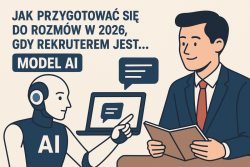
Imagine a job interview where there is no human on the other side — the questions are asked by an intelligent AI system, and your answers are evaluated by an algorithm. Not long ago, such a scenario sounded futuristic, but in 2026 it is becoming increasingly common. Companies (especially in the IT sector) are eagerly adopting AI in recruitment to speed up processes and make candidate evaluations more objective. For job seekers — especially IT juniors — this means the need for a new approach to preparation. In this article, we explain how AI-driven recruitment models work and how to prepare for job interviews conducted by artificial intelligence. We’ll discuss the latest trends, changes in interview formats, technical and “soft” preparation methods, examples of AI tools used in Poland, as well as best practices (including a list of common mistakes made by junior candidates).
AI in IT Recruitment — The New Trend of 2026
Artificial intelligence is playing an increasingly important role at every stage of recruitment. According to LinkedIn’s report, 73% of recruiters believe AI is changing how recruitment is conducted, and 37% of organizations have already implemented or are testing AI tools in this area. The Polish job market is not lagging behind — nearly half of Polish recruiters already use AI to analyze CVs, and most large companies plan to automate their recruitment processes in the coming year. In practice, this means candidates increasingly encounter AI during screening and interview stages:
Initial candidate preselection — algorithms scan CVs for keywords and job requirements, quickly identifying top matches. AI-supported ATS systems automatically reject applications that don’t meet criteria and forward only promising candidates.
Recruitment chatbots — intelligent assistants (e.g., Olivia by Paradox or Mya Systems) conduct initial chat-based interviews, ask basic qualification questions, fill in missing CV details, and even schedule the next interview stages. They work 24/7, improving communication with candidates and offloading repetitive tasks from HR teams.
Technical skill assessment — coding test platforms (such as Codility, HackerRank, and others) use automated code evaluation. The candidate solves a task online, and the system checks correctness and efficiency. These tools offer objective coding-skill verification and save time by focusing only on top candidates.
Soft-skill and fit analysis — advanced AI systems can evaluate video recordings of interviews. For example, HireVue analyzes body language, facial expressions, tone of voice, and word choice. Based on this, the algorithm assesses personality traits, confidence, engagement, and predicts cultural fit. In Unilever’s global recruitment process, implementing such AI saved 100,000 recruiter work hours and generated approx. $1 million in savings.
Why are companies doing this? The reasons are simple: time and cost savings, scalability, and the desire for more objective evaluations. AI can analyze thousands of applications or conduct hundreds of interviews in seconds — something impossible for humans. It also asks every candidate the same questions and evaluates based on the same criteria, supporting standardization and reducing bias (humans have unconscious biases or simply bad days — algorithms are “in the same mood” at all times). Companies also claim AI increases fairness: candidates are assessed on competence and actual answers, not on a “shared hobby” brought up during a casual conversation with a human recruiter. Many HR specialists confirm that AI increases recruitment efficiency and improves the match between candidates and roles.
Of course, AI is not a cure-all. Ethical concerns remain — e.g., whether algorithms are truly bias-free. A well-known case involved Amazon, which abandoned its internal AI CV-evaluation system when it turned out to discriminate against women (it favored “male-coded” language in CVs). Despite such incidents, the trend is clear: the recruiter of the future is an AI-enhanced recruiter. In 2026, in many companies the candidate’s first “interviewer” will indeed be an AI model, not a human.
The New Job Interview Format — How Is an AI Interview Different?
Since an “AI recruiter” may be part of the process, it’s worth understanding what such an interview looks like and how it differs from a traditional one. Here are the key differences:
• **Asynchronous (recorded) interviews ** A popular format today is the one-way video interview. The candidate receives a link (e.g., to HireVue) and records answers to a set of predefined questions at their convenience. Typically there are 3–5 questions; before each answer you get several seconds to prepare, and then 2–3 minutes to respond. After recording, the video is analyzed by AI and (often) reviewed by a recruiter. There’s no live interaction, so you don’t need to schedule a time — you just respond before the deadline. It’s convenient because you can prepare your surroundings and, in some platforms, even re-record answers. The downside is zero real-time feedback — no human means no reactions, which can feel strange. (Tip: practice speaking to the camera beforehand to feel more comfortable.)
• Chatbot instead of a phone screening
The traditional screening call is increasingly replaced by a chat-based interview with a bot. The chatbot asks questions in text form, and the candidate replies like in a messenger. This can be less stressful for introverts, but note: the system usually measures response time and analyzes language similarly to video. The chatbot follows a predefined script — it won’t naturally explore interesting topics unless programmed to. There is no “human touch” — no small talk, no improvisation, no warm-up chatter.
• Standardized questions and scoring
In an AI interview, every candidate gets the same questions, in the same order and format. No surprises, no spontaneous tangents. Scoring is fully standardized: systems use predefined criteria (e.g., keywords, completeness, tone). Human recruiters, on the other hand, are more subjective and rely partly on intuition. AI won’t be impressed by an off-topic anecdote, but — importantly — it also won’t misjudge you because of a nervous tic.
• Impersonal experience vs. empathy
Candidates often report that AI interviews feel more impersonal. No smiles, no nodding, no empathetic reactions. The model might show a “👍” icon (if programmed), but it won’t build rapport. Ironically, even though AI doesn’t “feel” your body language, it analyzes it technically. AI interviews tend to be more predictable and shorter — if the script is 20 minutes, it won’t stretch to an hour.
Human vs. AI interviews: AI handles scale, speed, and consistency extremely well, but lacks human empathy and contextual intuition. That’s why many companies use a hybrid approach: AI for early stages, humans for final rounds — ensuring both efficiency and human judgment.
How to Prepare Technically for an AI Interview Core knowledge
Regardless of interviewer type, you must know the fundamentals required for the role. For IT juniors, this typically means solid programming basics, knowledge of one or two languages, data structures and algorithms at junior level, and familiarity with practical tools (version control, basics of SQL, etc.).
AI may test this in different forms:
A technical chatbot may ask theoretical questions (“What’s the difference between a list and an array in Python?”, “Name the core OOP principles”).
A coding assessment system may require solving a small task in an online editor — without assistance from another person.
Sample technical questions (for IT juniors):
Write a function that finds the second smallest number in a list.
Explain the concept of “delegation” in OOP.
Here is a faulty code snippet — identify the bug.
What is the time complexity (Big-O) of QuickSort?
What is the difference between HTTP and HTTPS?
How AI evaluates your code and answers
AI and coding platforms check:
Correctness (do all tests pass?)
Efficiency (is the solution optimal enough?)
Style and logic (clean structure, meaningful variable names, no hard-coding)
They can also detect unauthorized AI-generated code — through writing patterns, timing, or typical model structures. (Advice: complete tasks honestly. Cheating often leads to automatic disqualification.)
Technical setup
If your interview includes video recording, check your camera, mic, internet connection, and test the platform. If it’s a chat interview, prepare a quiet environment, type clearly and in full sentences (AI evaluates writing like a spoken answer). For online coding tasks, practice coding in the browser without IDE assistance. Some companies allow AI-based autocomplete tools (like GitHub Copilot), but only if explicitly permitted. Be ready to work without such tools.
**How to Prepare for the “Soft” Side of an AI Interview ** AI evaluates soft skills too — but algorithmically.
What AI measures
Systems like HireVue analyze:
Word choice and clarity
Structure (e.g., STAR method)
Tone and body language
Engagement and confidence
Reading from notes, monotone delivery, averted gaze — all may lower your score.
Preparing for behavioral questions
AI interviews often include 60–70% behavioral questions. Typical themes: teamwork, conflict, deadlines, stress, initiative.
Prepare stories from your experience using the STAR method. Avoid generalities — be concrete and emphasize your individual contribution (“I did…”, not only “we did…”).
AI analyzes your reasoning, mindset, and problem-solving approach.
Body language and voice
If recording video:
sit straight
look toward the camera
avoid fidgeting
speak clearly, not too fast
use natural tone and facial expression
AI evaluates energy level, fluency, engagement.
During chat interviews — write professionally, avoid emojis and overly casual tone.
Cultural fit
AI may analyze text for values alignment. If the company emphasizes “innovation and collaboration”, use examples showing problem-solving, teamwork, creativity. Research the company beforehand.
Important: treat AI interviews as seriously as human ones. A common junior mistake is becoming too casual (“it’s just a bot”). Remember — someone will eventually see your answers or the AI report.
AI Tools and Platforms in IT Recruitment (Poland 2026)
What specific AI tools might you encounter when applying to IT companies in Poland? Below are several examples of AI-powered recruitment platforms already used by Polish employers or the local branches of global corporations:
HireVue – a popular platform for AI-driven video interviews. Candidates record their responses to questions, and HireVue analyzes the recordings using AI, evaluating both content and non-verbal communication (body language, tone of voice, etc.). It is used in high-volume recruitment for internships and junior roles (companies such as Unilever, Goldman Sachs, IBM and others have used it). The platform also offers situational judgment tests and recruitment games that assess candidate traits.
Paradox Olivia – an intelligent recruitment chatbot from Paradox. Olivia can communicate with candidates during pre-screening: answer questions about the job offer, ask simple qualification questions, schedule interviews, and send reminders. It operates 24/7 on mobile devices, giving candidates the convenience of communicating at any time. In Poland, such bots may be used by large companies with continuous hiring needs (shared-service centers, retail, and large IT firms streamlining initial contact).
Mya Systems – another AI-based chatbot serving as a virtual HR assistant. Mya can ask questions about experience, request clarification of CV details, or even conduct a short chat-based qualification interview. Once data is collected, it passes it to recruiters along with an evaluation of the answers. This globally recognized tool is used in various industries, and in Poland it is often employed by high-volume recruitment agencies.
Codility – a platform for assessing programming skills. Very popular among Polish tech companies (and also banks, consulting firms, etc.). A candidate receives one or several coding tasks to complete online. Codility automatically runs unit tests on the submitted code and evaluates correctness and efficiency. This provides objective results, making it easy for companies to compare applicants based on their coding ability. In some cases, the platform also generates a report on coding style and problem-solving approach (e.g., whether all tests passed on the first attempt, how many submissions were made).
HireVue (Live Video Analysis) – it’s worth mentioning that HireVue is not limited to pre-recorded interviews: it also offers a Live module — a real-time interview with AI, or with a human recruiter supported by AI. These variants are gaining traction in 2026. Even now, AI can “listen in” on a live conversation (e.g., on Zoom) and provide the recruiter with key insights or follow-up prompts. There are also tools such as Metaview, which record the video call, generate a transcript, and produce a detailed AI-generated candidate evaluation report.
Skeptical AI – an example of a specialized tool that analyzes emotions in video recordings. It may evaluate motivation, enthusiasm, or confidence based on facial expressions and micro-expressions. Such solutions are still more common abroad, but the trend is reaching Poland. Their advantage is the ability to capture subtle cues often missed in standard interviews (e.g., genuine engagement), while the downside is the risk of errors or cultural misinterpretations of emotional expression.
ATS with AI modules – many Applicant Tracking Systems (ATS) used by employers (such as Poland’s eRecruiter or global solutions like Workday and SAP SuccessFactors) now integrate AI features. These modules automatically evaluate CVs, suggest top candidates, and can even generate feedback messages. A Polish all-in-one example is Recruitify, which offers a “virtual recruiter” that automates document analysis, talent search, and candidate communication. As a candidate, you may not directly notice the ATS, but it influences whether your application is ever seen by a human recruiter.
(Note: The tool names are provided for informational purposes — as a candidate, you usually cannot influence which platform the employer will use. Still, it is helpful to know what to expect. If you see HireVue in the interview invitation — you know you’ll be recording video answers for AI analysis. If you receive a Codility link — it almost certainly means a coding test. This helps you prepare more precisely.)
Tips and Best Practices — How to Train with AI and What to Avoid
Below is a collection of practical advice to help you get comfortable with AI-driven recruitment processes. These tips apply both to pre-interview practice and to behavior during the actual interview. We also highlight common mistakes junior candidates make — so you can avoid them.
Training with AI
Practice answers with AI – just as athletes spar before competition, you can run a mock interview using AI tools. There are apps built for this purpose, such as Interview Warmup by Google (a free simulator with typical questions and answer analysis), or platforms like Interviewing.io and MyInterview, where you can rehearse with a chatbot asking role-specific questions. Some tools (e.g., Big Interview) let you record your video answers and receive automated AI feedback showing how you perform in terms of body language, fluency, or eye contact. This feedback is extremely valuable — you may learn, for example, that you look away too often or speak too fast under time pressure.
Use ChatGPT as a coach – if you don’t have access to dedicated tools, simply use ChatGPT (or another generative model) to prepare. Ask it: “Conduct a mock interview for a Junior Java Developer role. Ask technical and behavioral questions, wait for my answer, then give me feedback.” This type of mock interview reveals likely questions and helps you test your responses. Just remember not to memorize perfect AI-generated answers — instead focus on the structure and how to improve your delivery. You can also ask the AI to analyze your CV and prompt: “What questions might I get with this resume?”
Analyze your recordings – record yourself (audio or video) answering example questions, then watch or listen critically. You can also use AI to transcribe your recording and ask a model to evaluate clarity and style. Even one practice recording can make a big difference: you become used to your own voice, you see yourself “through the recruiter’s eyes,” and you often notice quick fixes (pen tapping, slouching, frequent “umm’s”) before the real interview.
Learn the language of key competencies – AI models rely heavily on keyword-based evaluation. During your preparation, write down the competencies valued for your role (e.g., “problem solving,” “proactivity,” “attention to detail,” “willingness to learn”). Try to weave this vocabulary naturally into your responses. Not artificially — but name things clearly. For example, instead of saying: “I completed project X on time,” you could add: “Thanks to effective teamwork and good time management, we delivered project X ahead of schedule.” Algorithms can detect such cues and boost your score in categories like teamwork or organizational skills.
What to Avoid — Common Mistakes Made by Juniors
Being overly scripted or robotic – using AI for preparation is helpful, but overdoing it is a trap. Don’t be the candidate who memorizes “perfect” ChatGPT-generated answers that sound machine-written. AI on the recruiter’s side may flag your responses as overly generic or suspiciously formulaic. Remember: authenticity is an asset. Use AI suggestions, but speak in your own voice and use real personal examples. Experts note that excessive reliance on prewritten AI answers often makes candidates sound artificial and impersonal.
Ignoring the interview format – some juniors underestimate the specifics of AI interviews. For example, they don’t look at the camera when recording because “it’s not a real conversation with a person.” That’s a mistake: lack of eye contact will be interpreted negatively (as low confidence or engagement). Another example: writing short, sloppy messages in a chat interview because “it’s only a bot.” This harms clarity and professionalism. Tip: Maintain professional communication standards even when speaking to a machine. Use complete sentences and behave as if a real person were observing — because eventually one will.
Underestimating motivation/company questions – juniors often focus on technical topics and neglect “softer” questions like “Why do you want to work here?” or “What do you know about our company?”. In an AI interview, these questions may appear in a form field or chat, and some candidates respond with a single sentence because they don’t feel the pressure of talking to a person. Big mistake — you must show motivation and research even to an algorithm. If you write only: “Because you’re a cool company and I want to grow,” the AI will likely give you a very low score. Provide concrete reasons and enthusiasm — the algorithm (and later the humans) will reward clear, thoughtful answers.
Multitasking during the interview – it may seem that you can glance at notes or Google something while talking to a bot. Be careful: many platforms monitor browser activity and detect if you minimize the window or switch tabs (which suggests you’re reading answers). Some AI systems also catch unnatural pauses typical of someone reading from the screen. Therefore, avoid unauthorized aids during the session. Prepare your talking points beforehand but try to speak naturally. If the interview is recorded, look into the camera — not at your notes.
Forgetting the basics – stress and unfamiliar interview formats can cause you to overlook fundamental good practices. For instance, when finishing a recorded answer, don’t immediately break eye contact or sigh — keep a neutral expression for a moment before ending the recording. In chat interviews, don’t forget polite phrases when appropriate — even a bot may pass them on. Another good habit is to prepare for the final question: usually “Do you have any questions for us?” AI systems sometimes skip it, but if you have a chance to leave a message or ask something, do it. Many juniors say “No, thanks,” missing an opportunity to show curiosity. Prepare one or two thoughtful questions about the role/project/company. If you can’t ask them in the AI stage, keep them for the next rounds.
Finally, remember: technology is a tool, not an enemy. Although interviewing with AI feels different from a traditional process, the right preparation will make you feel confident. Ultimately, companies still look for capable, motivated people — AI is simply a way to find them more efficiently. Focus on your skills, present your best self (both on camera and in code), and no algorithm will stand in your way. On the contrary — it may help you shine among hundreds of candidates through objective evaluation. Mya Systems — AI recruitment assistant conducting chat-based interviews and collecting structured candidate data.
Codility — widely used in Poland for programming skill assessments. Automatically evaluates correctness, efficiency, coding style, and generates candidate reports.
HireVue (Video Analysis) — worth mentioning again as it is increasingly used for video-based AI assessments.