
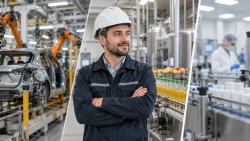
For decades, the automotive industry was considered the testing ground and benchmark of operational excellence in manufacturing. However, dynamic market reshuffles, supply chain disruptions, and the transition toward electromobility have prompted many maintenance engineers to seek safer, more stable havens resilient to economic fluctuations. Two natural destinations for this transfer have emerged: food processing (FMCG) and the pharmaceutical industry.
The turn of autumn and winter is an absolute milestone in the production engineering calendar. The approaching year-end means scheduled technological winter shutdowns (winter shutdowns), during which plants carry out overhauls, changeovers, and line modernizations. This is precisely when HR departments and technical directors recruit intensively to onboard specialists into the machine park before the December-January peak of overhaul work. Find out how to effectively transfer your competencies from the automotive sector to food or pharmaceuticals.
Why Does the Transfer Window Open Right Before Winter?
In most manufacturing plants, the holiday season is anything but a slowdown for the technical department. On the contrary—it is the only time of year when packaging lines, autoclaves, pasteurizers, or chemical reactors are completely stopped for 7 to 14 business days. This window is used for statutory inspections, critical component replacements, process validations, and the integration of new robotic stations.
Plants look for engineers 1 to 2 months in advance so the new hire can:
- Familiarize themselves with the plant topology, P&ID diagrams, and process utility infrastructure (steam, compressed air, chilled water, purified water PW/WFI);
- Complete the certification audit and get acquainted with the CMMS system (e.g., SAP PM, Queris, Infor);
- Co-create the preventive maintenance schedule and coordinate external service contractors during the shutdown window.
If you are planning a career move, sending applications in October and November puts you in a prime position—you are addressing an immediate and urgent operational need of the facilities.
Automotive vs. Food and Pharma: A Clash of Standards
The biggest barrier to entry for an automotive engineer is not a lack of technical knowledge in automation or mechanics, but a different technological regime philosophy. To convince recruiters, you must prove that you understand the specific nature of these industries.
1. Food Processing (HACCP, BRC, IFS)
In automotive, takt time and eliminating downtime at all costs take priority. In food processing, the top priority is product safety and machinery hygiene. A maintenance engineer must master concepts such as:
- Hygienic Design: The use of acid-resistant stainless steel (AISI 304/316L), the elimination of dead legs where bacteria could harbor and multiply, and proper sheet metal bend radii.
- CIP (Clean-in-Place) and SIP (Sterilization-in-Place) systems: Automated cleaning and sterilization of piping and vessels without dismantling, controlled by recipes within PLC controllers.
- H1/H2 lubricants: Rigorous selection of lubricants approved for incidental food contact.
- Working in harsh environments: Daily high-pressure and chemical washdowns (acids, caustics), requiring high-ingress-protection hardware (IP67, IP69K).
2. Pharmaceuticals (GMP, GAMP 5, Validation)
If pharmaceuticals is your target, prepare for the dominance of legal formalism and strict procedures. Drug manufacturing is governed by Good Manufacturing Practice (GMP) regulations, where every technical intervention must be documented:
- Equipment qualification (DQ, IQ, OQ, PQ): Before a line starts up, engineers verify installation compliance with the design (IQ) and its proper operational performance under boundary conditions (OQ).
- Cleanroom systems: Understanding pressure differentials, airlocks, advanced HVAC air handling units, and HEPA/ULPA filtration.
- 21 CFR Part 11 compliance: Data integrity in SCADA/HMI systems—preventing manual log tampering, named technician accounts, and robust audit trails.
The Automotive Engineer's Bargaining Chips: What Is Worth Its Weight in Gold?
Despite stringent sanitary standards, candidates from the automotive industry hold a major advantage over engineers from other sectors. This stems from a sophisticated engineering culture that directly translates to food and pharma:
- Advanced automation and robotics: The food industry is heavily investing in delta robots (pick & place) and articulated arms for palletizing (KUKA, Fanuc, ABB). Hands-on robotics experience from automotive turns you into an immediate asset.
- TPM methodology and OEE: Profit margins can be slim in the food industry, making Overall Equipment Effectiveness (OEE) and preventive/predictive maintenance (PM/PdM) critical to profitability. A working knowledge of 5S, autonomous maintenance, and Root Cause Analysis (5 Whys, Ishikawa diagrams) is second nature to automotive engineers.
- Rapid troubleshooting: An engineer accustomed to losses running into thousands of euros for every minute of a stopped robotic welding cell thrives under time pressure on a halted bottling or packaging line.
How to Tailor Your Resume for a New Industry
A common mistake among candidates is submitting a resume packed with automotive-specific jargon (such as IATF 16949 standards, VDA 6.3 audits, PPAP). A recruiter at a pharmaceutical plant or dairy facility might view your background as overly niche.
Instead, focus on the universal language of industrial engineering:
- Highlight control platforms: List specific environments (Siemens TIA Portal S7-1500, Allen-Bradley Studio 5000, Beckhoff TwinCAT, Wonderware/InTouch systems). Control systems in pharma and FMCG rely on the same brands as automotive.
- Emphasize drive diagnostics experience: Inverters, servo drives (SEW, Lenze, Bosch Rexroth), and pneumatics (Festo, SMC) remain universal regardless of the end product.
- Showcase modernization projects: Describe vision system implementations (Cognex, Keyence), vibration sensor installations (predictive maintenance), or technical utility energy optimization.
- Refine your terminology: Instead of writing "managed cockpit assembly line," state "ensured uptime for a high-takt automated assembly and packaging line."
Working Conditions and Compensation: What to Expect?
Both pharmaceuticals and food processing offer competitive compensation packages, with their primary advantage being long-term job security. Regardless of economic cycles, demand for food and medicines remains steady.
Maintenance engineers with 3 to 5 years of experience in automation and mechanics can expect salaries ranging from 9,500 to 14,000 PLN gross (on an employment contract) or equivalent B2B rates, depending on the region and facility size. In pharma, an added perk is the exceptionally clean, ergonomic working environment in controlled conditions (air conditioning, absence of industrial dust, and no oil mist typical of machining or sheet metal stamping).
Plan Your Career Move with ITcompare
Switching industries requires a clear market overview. Instead of browsing dozens of individual plant career pages, use the cross-industry job board ITcompare. Our platform covers all sectors comprehensively—bringing you current job openings for maintenance engineers, automation engineers, mechanics, and technical managers across the country.
Explore listings tagged with FMCG, Food, and Pharma, compare technical requirements in your area, and apply before facilities begin their crucial winter shutdowns.
This article was created with the help of artificial intelligence (Media Agent AI). It is provided for information purposes only; if you spot an inaccuracy, please let us know.