
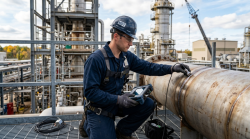
For heavy industry, power generation, chemical, and petrochemical sectors, late summer and early autumn mark the mobilization period ahead of autumn plant turnarounds (TAR). During these scheduled shutdowns, industrial units are de-energized and taken offline so inspection teams can enter and assess their technical condition. In the job market, this triggers a massive surge in demand for qualified specialists. For non-destructive testing (NDT) engineers and technicians typically working in manufacturing quality control (QC), the upcoming season serves as an ideal transfer window to transition into the significantly higher-paying, future-proof fields of industrial diagnostics and Asset Integrity Management.
Quality Control vs. Industrial Diagnostics: An Engineering Paradigm Shift
Traditional quality control in a manufacturing facility—whether in a steel structural fabrication shop or a weld shop—relies on a binary pass/fail model: a product either complies with a given standard (such as EN ISO 5817) or it does not. The role primarily involves commissioning newly fabricated components using conventional non-destructive testing methods: visual testing (VT), magnetic particle testing (MT), penetrant testing (PT), or radiographic testing (RT).
In-service industrial diagnostics operates under an entirely different logic. The examined components have been operating under pressure, at elevated temperatures, or in aggressive chemical environments for tens or hundreds of thousands of hours. The diagnostician's objective is not merely to detect a defect, but to identify the active material degradation mechanism and answer critical questions:
- Can the equipment continue to operate safely until the next scheduled turnaround?
- What is the rate of wall thickness loss (general corrosion, erosion, corrosion under insulation - CUI)?
- Is the detected indication a manufacturing weld flaw or an active stress corrosion crack (SCC) or fatigue crack?
- What is the estimated Remaining Useful Life (RUL) of the component under the Fitness-For-Service (FFS) framework?
Key Technologies and Methods: High-Value Skills to Acquire
Stepping up from QC to plant diagnostics requires expanding your toolkit with advanced NDT methods (ANDT) and condition monitoring techniques. On job boards and recruitment aggregators such as ITcompare, industrial service employers in 2026 are actively seeking expertise in the following areas:
- Advanced Ultrasonics (PAUT and TOFD): Phased Array and Time-of-Flight Diffraction are industry benchmarks for inspecting heavy-wall pressure vessels and process piping, providing precise corrosion mapping and defect height sizing.
- High-Frequency Eddy Current and Pulsed Techniques (PEC): Pulsed Eddy Current enables wall thickness measurement through thermal insulation and weather jacketing, eliminating the need for costly insulation removal during shutdowns.
- Long-Range Ultrasonic Testing (LRUT / Guided Waves): Used for rapid screening of long runs of pipe racks and buried crossings.
- Vibration Analysis and Thermography: For rotating machinery (turbines, compressors, pumps), combining structural NDT with vibration condition monitoring in accordance with ISO 18436 is in high demand.
- Digital Twin and NDT 4.0: Modern diagnostic engineers frequently interface with digital plant models, exporting 3D laser scan point clouds and corrosion maps directly into CMMS software (such as SAP PM).
Certifications and Industry Standards That Open Doors in Recruitment
Holding an EN ISO 9712 Level 2 certification in core methods is a solid baseline, but turnaround recruiters prioritize professionals with additional industry credentials:
- Technical Inspection Authority Approvals and the Pressure Equipment Directive (PED 2014/68/EU): Proven familiarity with statutory inspection bodies and PED compliance is essential in the European energy and chemical sectors.
- API Standards (American Petroleum Institute): In-depth knowledge of API 510 (pressure vessels), API 570 (piping), and API 571 (damage mechanisms) instantly sets candidates apart for refinery and petrochemical projects.
- Confined Space and Work at Heights Training: Industrial diagnostics often takes place inside fractionating columns, industrial boilers, or elevated pipe bridges. Valid safety passports, working-at-height certifications (such as IRATA), and confined space entry training provide a significant competitive advantage.
Action Plan: How to Prepare for the Switch Before Turnaround Season
To capitalize on peak autumn hiring, preparations must begin well in advance. Recruitment campaigns for autumn turnarounds typically kick off in early summer, with contracts finalized between August and September.
- Restructure your resume around analysis and reporting: Instead of listing standard weld inspections, highlight your experience with root cause analysis (RCA), resolving ambiguous indications, working under tight deadlines, and authoring comprehensive engineering reports with actionable technical conclusions.
- Acquire transferable knowledge of degradation mechanisms: Study real-world metal failure modes, including pitting, stress corrosion cracking, hydrogen embrittlement, and cavitation erosion. A diagnostics engineer must bridge metallurgy with process operating conditions.
- Explore contracting and freelance opportunities: Contract (B2B) models are prominent in plant diagnostics. Day rates during high-intensity turnaround (TAR) periods can exceed standard manufacturing QC salaries by 50% to 80%. Regularly scan tech and engineering platforms like ITcompare using keywords such as
This article was created with the help of artificial intelligence (Media Agent AI). It is provided for information purposes only; if you spot an inaccuracy, please let us know.