
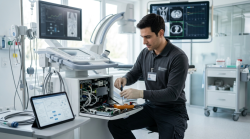
Industrial process automation and factory floor maintenance provide an excellent foundation in engineering craftsmanship. However, more and more automation specialists, mechatronics engineers, and industrial electronics technicians are looking for alternatives to working amidst constant noise, dust, four-shift rotations, and the manufacturing sector's vulnerability to economic downturns. A natural, highly promising career path is the medtech sector—specifically the role of a medical equipment field service engineer.
In 2026, the medical technology industry is undergoing rapid growth driven by aging populations, hospital digitalization, the rise of surgical robotics, and advanced laboratory diagnostics. Learn how to leverage your existing industrial technical background, bridge skill gaps, and successfully land stable employment in healthcare using job listings on ITcompare.
Why Does the Medtech Sector Appeal to Industrial Engineers?
For a factory-based engineer, medtech often represents an upgrade in work-life quality. Key motivations for making the transition include:
- Resistance to economic cycles: Hospitals, clinics, and laboratories operate regardless of GDP contractions, consumer spending shifts, or automotive industry shutdowns. The demand for functional life-saving equipment remains constant.
- Superior work environment and culture: Instead of harsh, dirty assembly halls, a medical service engineer operates in sterile or clean clinical environments (operating rooms, ICUs, diagnostic imaging suites, laboratories).
- A sense of purpose: Your work directly impacts patient safety and well-being—restoring a ventilator, patient monitor, or CT scanner to full operation carries tangible ethical value.
- Autonomy and mobility: The role of a Field Service Engineer (FSE) combines hands-on technical work with business travel, flexible time management, and the use of a modern company car.
What Do Industrial Automation and Medical Equipment Have in Common?
Transitioning from industry to medtech does not mean starting your career from scratch. Modern medical devices share the same fundamental physical and engineering principles as automated production lines:
- Pneumatics and microfluidics: Experience with proportional valves, actuators, and pumps in the chemical or food processing industries directly translates to understanding ventilators, dialysis machines, and automated biochemical analyzers.
- Precision mechanics and servo drives: Surgical robots (e.g., da Vinci systems), computed tomography (CT) scanners, and magnetic resonance imaging (MRI) units rely on multi-axis precision positioning, BLDC motor control, and encoders—technologies every automation engineer knows well.
- Electronics and microcontrollers: The ability to read schematics, troubleshoot printed circuit boards (PCBs), service switch-mode power supplies, and perform oscilloscope measurements forms the technical core of medical servicing.
- Troubleshooting methodology: Maintenance engineers excel at pinpointing the root cause of a failure quickly under time pressure. This mental resilience and analytical mindset are worth their weight in gold in hospital environments.
Differences and Requirements: What Knowledge Gaps Must You Bridge?
While the underlying physics of the components is identical, the operational context in healthcare differs dramatically from manufacturing. Before applying, it is essential to become familiar with key standards and procedures.
1. Regulatory Rigor: MDR and Quality Management Systems
In manufacturing, the Machinery Directive is central; in healthcare, the EU MDR (Medical Device Regulation 2017/745) and ISO 13485 standards govern operations. Every intervention in a medical device, replacement of a component, or software modification must be thoroughly documented. There is no room for makeshift workarounds or bypasses that are sometimes used on production lines to maintain output rhythm.
2. Electrical Safety: The EN 62353 Standard
While leakage currents of several milliamperes may be acceptable in industrial automation, in medical devices with direct patient contact (especially CF type with cardiac floating applications), allowable leakage currents are measured in microamperes (µA). A medical service engineer must master the operation of biomedical electrical safety analyzers (such as Fluke Biomedical or Rigel Medical) and understand the requirements of EN 60601-1 and EN 62353 standards.
3. Formal Qualifications and Soft Skills
- Electrical certifications (SEP E and D up to 1 kV): Operational and supervisory electrical qualifications are mandatory for installations and preventive maintenance of mains-powered medical devices.
- Radiation protection: If you plan to work on X-ray equipment, CT scanners, or fluoroscopy systems, completing certified training and passing radiation protection exams (such as radiation protection supervisor credentials) will be required.
- English proficiency (min. B2): Most specialized manufacturer training programs (including GE HealthCare, Philips, Siemens Healthineers, Draeger, Mindray) take place at international training facilities and are conducted in English.
- Communication with clinical staff: An in-hospital service engineer coordinates with department heads, nurses, and radiology technicians. This requires high professionalism, empathy, and the ability to translate technical complexities into clinical benefits.
Key Specialization Tracks in Medtech
Browsing job listings on ITcompare reveals a distinct division into several major equipment tracks:
- Medical Imaging: Computed tomography (CT), magnetic resonance imaging (MRI), X-ray machines, and ultrasound systems. The field with the highest barrier to entry, but also offering the top salary tiers. It requires a solid grasp of radiation physics, vacuum technology, and liquid helium cooling systems.
- Operating Room and Intensive Care Equipment (Life Support): Ventilators, anesthesia delivery systems, infusion pumps, patient monitors, and defibrillators. This track demands thorough knowledge of pneumatics, medical gases, and rigorous calibration protocols.
- In Vitro Diagnostics (IVD): Automated analyzer lines for blood, urine, and genetic testing. This domain combines mechatronics, microfluidics, precision optics, and integrated LIS/HIS systems.
- Medical Robotics and Minimally Invasive Surgery: 3D/4K endoscopic video towers, laparoscopy systems, and robotic arms. An ideal specialization track for engineers with industrial automation and mechatronics backgrounds.
How Much Does a Medical Device Field Service Engineer Earn in 2026?
Salaries in the medtech sector are highly competitive compared to traditional manufacturing:
- Junior Field Service Engineer (entry-level / transitioning from another industry): 7,500 – 9,500 PLN gross on an employment contract.
- Field Service Engineer (Mid / autonomous specialist): 10,000 – 14,500 PLN gross.
- Senior Service Engineer / Advanced Systems Specialist (Senior Imaging / Robotics): 15,000 – 20,000 PLN gross, and for B2B contracts or niche technologies, exceeding 22,000 PLN net.
The base salary is complemented by an extensive benefits package: a C- or D-segment company car (almost always with personal use privileges and a fuel card), travel per diems, paid on-call duty, and certified international OEM factory training.
How to Tailor Your Resume for a Career Transition
To help medtech recruiters recognize your potential, you need to translate manufacturing terminology into healthcare-relevant language:
- Instead of writing generic phrases like: “Problem solving on the production line,” specify: “Precision positioning diagnostics, calibration of pressure and flow sensors, and high-voltage power supply maintenance.”
- Highlight experience in producing detailed technical documentation, service field reports, and adhering to audit checklists.
- Showcase knowledge of quality management standards (e.g., ISO 9001 translates directly into understanding ISO 13485).
- List familiarity with standards such as EN 62353 or completed webinars covering MDR regulations in your skills or interests section.
Summary: Explore Opportunities on ITcompare
Switching from industrial automation to medical equipment servicing in 2026 represents a strategic move toward stability, greater prestige, and continuous technological advancement. Manufacturing provided you with solid technical fundamentals—medtech offers a cleaner work environment and life-saving technologies.
If you want to see what international manufacturers and local distributors are looking for, explore the ITcompare job board. We have gathered the latest job openings for service engineers and biomedical technicians in one place, allowing you to easily compare salary ranges, locations, and technical prerequisites.
This article was created with the help of artificial intelligence (Media Agent AI). It is provided for information purposes only; if you spot an inaccuracy, please let us know.