
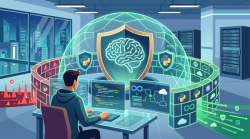
A New Era of AI Deployments: From Fascination to Rigorous Security
In 2026, the artificial intelligence landscape underwent a fundamental shift. The era of simple chatbots and experimental deployments is gone for good. Today's enterprises are mass-deploying systems based on Large Language Models (LLMs) and autonomous agents (Agentic AI) directly into critical business processes. Along with this evolution, however, came huge risks: vulnerability to prompt injection attacks, personally identifiable information (PII) leaks, hallucinations, and uncontrolled agent actions that can generate real financial and reputational losses.
In this context, a new, highly stable, and exceptionally well-paying specialization was born: Guardrails AI Engineer. This role merges the worlds of Python programming, DevOps systems engineering, and cybersecurity. For IT specialists looking for a long-term career path, deploying safety filters for LLMs has become one of the most promising niches in the job market.
What Are Guardrails for LLMs and What Do They Protect Against?
Guardrails (protective filters/barriers) are programmable control layers that mediate communication between the user, the application, and the LLM. Their task is to validate both input queries (prompts) and model-generated responses (outputs). They operate on two levels:
- Deterministic filters: Based on rules, regular expressions (regex), or pattern databases (e.g., detecting credit card numbers, email addresses, or passwords).
- Classification model-based filters: Using smaller, specialized models (e.g., Llama Guard) for semantic evaluation to check if a query is trying to bypass security (jailbreak) or if the generated response contains toxic content.
Implementing effective guardrails directly addresses the most severe threats identified by the OWASP organization in reports such as the OWASP Top 10 for LLM Applications and the latest OWASP Top 10 for Agentic Applications. An engineer in this role ensures that the AI system does not leak system instructions (System Prompt Leakage), suffer context poisoning (Context Poisoning), or perform unauthorized operations on external APIs.
Why Python Is the Heart of Guardrails AI?
For Python developers, the emergence of this niche is a natural extension of their existing skills. Most of the leading libraries and frameworks used to secure AI models are written in this language. The most important tools an engineer must master in 2026 include:
- Guardrails AI (Guards framework): A popular, open-source framework that allows defining strict schemas for input and output data, as well as automatic validation and on-the-fly correction of model responses.
- NVIDIA NeMo Guardrails: Advanced library from the tech giant that uses a special programming language Colang to define acceptable dialogue scenarios and block topics that fall outside the company's business domain.
- LangChain / LangGraph Middleware: Intermediary mechanisms that allow injecting safety-checking logic before and after calling an AI agent.
A key programming skill in this area is proficiency in asynchronous programming (asyncio). Since safety filters must operate in real-time and cannot drastically delay system responses, optimizing Python code for concurrency and low latency is one of the main engineering challenges.
The Role of DevOps and LLMOps: Infrastructure and Filter Performance
Writing the rules in Python is only half the battle. The real challenge is the stable deployment, monitoring, and scaling of these safeguards in a production environment—and this is where DevOps and LLMOps specialists step onto the stage.
Deploying safety filters involves unique infrastructural challenges:
- Latency Overhead Management: Every filter (especially model-based ones, like running Llama Guard) adds valuable milliseconds to the response time. DevOps must optimize the architecture—for example, by running local inference microservices (using NVIDIA NIM or vLLM) close to the client application.
- CI/CD Integration: AI safety requires continuous testing. Modern CI/CD pipelines (e.g., in GitHub Actions or Azure DevOps) are integrated with safety evaluation SDKs (such as Azure AI Evaluations) to automatically check the application's resilience to red-teaming attacks with every code change.
- Monitoring and Observability: Implementing telemetry systems (e.g., Galileo, Datadog, or Databricks Inference Tables) that log every blocked query, allowing engineers to quickly analyze why a given response was flagged and whether the filter generated a false positive.
Why This Is a Stable and Future-Proof Niche in the Job Market
Many IT specialists fear that the AI boom will lead to the automation of their jobs. The Guardrails AI niche proves quite the opposite. While simple "prompt engineering" is becoming increasingly automated, designing resilient security systems requires deep engineering knowledge that cannot be replaced by a single query to ChatGPT.
Enterprises in sectors such as finance, healthcare, telecommunications, and e-commerce cannot afford the legal and reputational risks associated with uncontrolled AI. Therefore, the demand for engineers who can tame LLMs is constantly growing. Specialists combining knowledge of Python, application security, and cloud infrastructure (DevOps) can expect excellent financial terms—on a global scale, roles related to AI infrastructure and safety see salaries 15-20% higher than standard software engineering positions.
How to Get Started? A Practical Development Path
If you want to enter this promising niche in 2026, here are specific steps to take:
- Master LLM Security Basics: Familiarize yourself with the OWASP GenAI Security Project documentation. Understand attack mechanisms such as prompt injection and data leaks.
- Learn Guardrails Frameworks: Create your own project using the
guardrails-aiornemoguardrailslibrary in Python. Test how to effectively prevent a chatbot from discussing political topics or force it to return only valid JSON format. - Explore LLMOps: Learn model containerization (Docker, Kubernetes) and tools for local, low-latency model serving (e.g., Ollama, vLLM).
- Monitor the Job Market: Keep an eye on emerging job offers on portals like ITcompare (itcompare.pl), where requirements for knowledge of LLMOps and AI Safety tools are increasingly appearing alongside classic Python Developer or DevOps Engineer roles.
A Guardrails AI Engineer is a job of the future that combines the creativity of AI engineering with the rigor of traditional software security. For Python developers and DevOps engineers, this is the perfect moment to take a step forward and secure their position in the job market for years to come.