
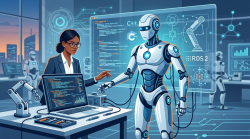
The year 2026 will go down in history as the moment when humanoid robots finally left research laboratories and entered production floors and logistics centers. Machines such as Figure 02 working in BMW factories, Digit from Agility Robotics supporting Amazon warehouses, and the bipedal NEO from 1X Technologies are no longer just technological curiosities. They have become a key element of the new industrial revolution.
According to the latest reports from 2026, the global robotics market grew by a spectacular 34% year-over-year, reaching a value of 38 billion dollars. There are already over a dozen commercial humanoid platforms available on the market for purchase or lease. This rapid expansion has created a massive talent gap. The most sought-after specialist has become the Humanoid Robot Integration Engineer. Why is it that C++ programmers and ROS (Robot Operating System) specialists are holding all the cards in this elite niche today? We explain this on ITcompare.
Who is a Humanoid Robot Integration Engineer?
In classic industrial robotics, programming relied on repetitive trajectories and PLC controllers. An industrial robot integration engineer focused on rigid tasks within safety cages. In the case of humanoid robots, which must navigate environments designed for humans, this approach is useless. A humanoid robot must analyze its surroundings in real-time, maintain balance on uneven ground, and interact with objects of various weights and shapes.
An Integration Engineer is a specialist who builds a bridge between the robot's 'brain' (advanced artificial intelligence models, such as VLA – Vision-Language-Action) and its 'body' (physical actuators, sensors, and execution systems). The engineer's job is not simply to write Python code to run a neural network. It is about making this AI model operate in real-time, without causing latencies that could lead to the fall of a machine worth hundreds of thousands of dollars.
Why are C++ and ROS 2 the Foundations of this Revolution?
Deploying autonomous humanoid machines requires uncompromising performance. For this reason, the software stack of modern robots relies on two pillars: the C++ language and the ROS 2 framework.
1. C++ as a Guarantor of Determinism and Low Latency
In humanoid robotics, the control loop responsible for maintaining bipedal stability must operate at frequencies of hundreds or thousands of Hertz (Hz). Any millisecond delay (e.g., garbage collection in managed languages or Python's performance limitations) can end in disaster. C++ (with a particular focus on modern C++20 and C++23) offers:
- Full control over memory management: No unpredictable pauses in program execution.
- Computational performance: Crucial for Inverse Kinematics algorithms or Model Predictive Control (MPC).
- Integration with mathematical libraries: Such as Eigen or Pinocchio, used for modeling the dynamics of multi-joint systems.
2. ROS 2 – Industry Standard for Distributed Systems
ROS 2 (Robot Operating System) is a modern middleware that is an absolute standard in commercial deployments in 2026. ROS 2 solves key robot architecture problems through:
- Node-based architecture: Allows breaking down the system into smaller, independent processes (e.g., perception node, motion planning node, actuator control node).
- DDS (Data Distribution Service) communication: Guarantees reliable, secure, and deterministic data exchange between nodes with precisely configured Quality of Service (QoS).
- Out-of-the-box packages and tools: Such as MoveIt 2 (for planning collision-free arm movements) or Nav2 (for navigation and space mapping).
Engineering Challenges in 2026: What Does an Integrator Actually Do?
The work of a Humanoid Robot Integration Engineer goes far beyond standard coding. Their daily tasks include:
- Sensor Fusion & State Estimation: Combining data from vision cameras, LiDAR sensors, IMU units, and thousands of tactile sensors into a single, coherent robot state in real-time.
- Sim-to-Real (S2R): Testing robot behaviors in advanced simulation environments (e.g., NVIDIA Isaac Sim, MuJoCo, or Gazebo) and seamlessly transferring trained models to physical hardware.
- Integration of VLA (Vision-Language-Action) models: In 2026, up to 40% of new deployments use VLA models. The integrator's task is to ensure that a voice or visual command translates into precise motion trajectories for arms and grippers.
- Energy consumption optimization and safety: Tuning algorithms so that the robot consumes as little energy as possible while guaranteeing 100% safety in direct contact with humans.
Why is This the New Elite of the IT Job Market?
In the 2026 IT market, we observe clear saturation in areas such as traditional web development or basic data analysis. In contrast, the humanoid robotics sector suffers from a drastic shortage of qualified hands. Why is the entry barrier so high?
Pure software developers often do not understand physics, mechanics, and hardware limitations. On the other hand, old-school mechanical or automation engineers lack modern programming habits (such as Docker containerization, advanced CI/CD, clean C++ code, or knowledge of distributed architectures). Those who bridge these two worlds—understanding the physics of motion and being able to write efficient C++ code under ROS 2—can count on rockstar status in the tech industry.
Earnings in this niche are among the highest in the engineering sector, often exceeding the rates offered to classic systems programmers or cloud engineers. Companies like Tesla, Figure, Boston Dynamics, as well as European and domestic integrators of autonomous systems, are constantly searching for talent.
How to Enter This Niche and Where to Find Job Offers?
If you are a C++ programmer or already have experience with embedded systems and want to enter the world of humanoid robots, your career path should include:
- Mastering ROS 2: Focus on QoS mechanisms, Node Composition, and writing efficient C++ components.
- Understanding simulators: Tools like NVIDIA Isaac Sim are standard today in the Sim-to-Real process.
- Basics of control theory and kinematics: You need to understand how feedback loops, Kalman filters (for sensor fusion), and path planning work.
The market is growing rapidly, and the demand for integration engineers will only increase. To stay up to date with the most prestigious and best-paying job offers in this sector, it is worth regularly monitoring the market.
A convenient tool for this purpose is the ITcompare (itcompare.pl) portal. As an advanced job aggregator for the IT and telecommunications sector, ITcompare gathers the latest postings from multiple job boards in one place. Thanks to this, you will not miss any recruitment for positions related to robotics, C++, embedded systems, or artificial intelligence, giving you a full and clear overview of the dynamically changing job market.
Summary
The Humanoid Robot Integration Engineer is undoubtedly one of the professions of the future, becoming a reality in 2026. Combining the power of modern C++ and the flexibility of ROS 2 creates a unique working environment where code directly brings matter to life. For ambitious developers, this is the perfect moment to shift career direction and join the elite that is literally building the future with autonomous robot hands.