
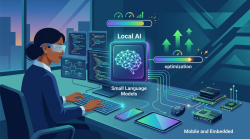
The Edge AI Revolution: Why the Cloud is No Longer Enough
As recently as 2024, the world marveled at giant language models (LLMs) like GPT-4, which processed data in massive data centers. However, 2026 has brought a fundamental paradigm shift. Companies have realized that sending every query to the cloud is not only expensive but also risky for privacy and too slow for real-time applications. Thus, the era of Small Language Models (SLM) was born.
Today, the SLM engineer is one of the most sought-after specialists on the ITcompare portal. This role bridges the world of Data Science with the precision of low-level engineering. If you are a mobile developer or an embedded systems engineer, you are facing the biggest career opportunity of this decade.
What Does an SLM Engineer Do in 2026?
An SLM engineer doesn't focus on training models from scratch on thousands of H100 processors. Their task is to take the vast knowledge contained in models like Llama 3.2 (1B/3B), Phi-4 mini, or Gemma 3 and "squeeze" it into a device that fits in a pocket or controls a robotic arm.
Key areas of responsibility include:
- Quantization: Reducing model weight precision from 16-bit to 4-bit or even 2-bit, which drastically reduces RAM requirements with minimal quality loss.
- Knowledge Distillation: A process where a smaller model "learns" from a larger one, inheriting its reasoning capabilities.
- NPU Optimization: Leveraging dedicated Neural Processing Units in the latest chipsets from Apple, Qualcomm, or Samsung.
- Memory Bandwidth Management: In 2026, the bottleneck is no longer computing power (TOPS), but memory bandwidth. An SLM engineer must be able to optimize the model so it doesn't drain the device's battery.
Why is This the Perfect Path for Mobile and Embedded Devs?
AI specialists often don't understand hardware constraints—power consumption, CPU cycles, or thermal limits. This is exactly where Android (Kotlin), iOS (Swift), and Embedded (C++, Rust) developers have an advantage. They know device architecture and how to manage resources.
In 2026, mobile applications are no longer just interfaces for APIs. Thanks to libraries like CoreML, TensorFlow Lite, or ExecuTorch, AI logic happens locally. A developer who can integrate an SLM model while ensuring offline functionality becomes invaluable to an employer.
Job Market and Salaries: Data from ITcompare
Analysis of job listings on ITcompare shows that demand for engineers capable of implementing "Private AI" has grown by 140% year-over-year. Companies in the medical, automotive, and fintech sectors are looking for experts who can guarantee that user data never leaves the device.
Salaries in this niche in 2026 significantly exceed standard rates for Senior Mobile Developers. Specialists who combine model optimization skills with native programming can expect bonuses of 20-30% compared to "regular" developers, and their role is crucial in Physical AI projects (robotics, wearables).
How to Start? Your Roadmap for 2026
- Master optimization frameworks: Focus on ONNX Runtime, OpenVINO, and LoRA (Low-Rank Adaptation) technology for local model fine-tuning.
- Understand Transformer architecture: You don't need to be a mathematician, but you must know how Attention Mechanisms work and why they consume so much memory.
- Experiment with local models: Download models from the SmolLM2 or Qwen3 families and try running them on a Raspberry Pi or smartphone, measuring power consumption.
The future of IT does not belong to those who can connect to the OpenAI API. It belongs to those who can make intelligence available wherever there is no internet, and where every millisecond and every percentage of battery life counts.