
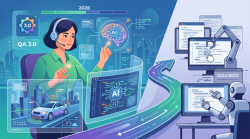
Evolution of the Role: From Clicker to Trust Architect
Just a few years ago, the peak of ambition in Quality Assurance was proficiency in Selenium or Cypress. However, 2026 has brought a fundamental paradigm shift. In a world where over 60% of production code is generated or optimized by artificial intelligence, the traditional approach based on rigid scripts (deterministic testing) is no longer enough. Welcome to the era of QA 3.0 Engineer.
The End of the Era of Determinism: Why Old Tests Fail
Traditional automated tests rely on simple logic: "if input is A, output must be B." However, systems based on LLMs (Large Language Models) and autonomous agents are probabilistic. This means that for the same query, the system may generate different, though substantively correct, answers. A QA 3.0 Engineer no longer checks if a comma is in the right place, but whether the model's intent and safety fall within defined boundaries.
AI Black-Box Testing and XAI
In 2026, testing systems whose internal logic is opaque to humans has become a key competency. Instead of writing thousands of test cases, QAs use techniques such as:
- Adversarial Testing: Deliberately introducing data designed to "trick" the AI model to detect security vulnerabilities and bias.
- Explainable AI (XAI): Using interpretability tools to understand why a model made a specific credit or medical decision.
- Model Drift Monitoring: Automatically detecting when a model loses precision due to changing market data.
Digital Twins and Physical Simulations – QA in the Real World
Another pillar of QA 3.0 is Physical AI. Software controlling robots, autonomous vehicles, or smart factories cannot be tested "live" without enormous risk. Therefore, physical simulations based on Digital Twins have become the standard.
QA engineers in 2026 work in environments like NVIDIA Omniverse or Unity, where they test code in photorealistic simulations that account for the laws of physics, friction, or changing atmospheric conditions. Software testing has become inextricably linked with mechanical engineering and sensor technology.
How to Prepare Your Career for 2026?
Browsing the latest job offers on ITcompare, it's easy to see that requirements for testers are evolving. To stay competitive, it's worth focusing on:
- Data Science Fundamentals: Understanding statistics and the ML model lifecycle.
- Prompt Engineering for QA: The ability to build testing agents that can independently explore an application.
- Green Testing: Optimizing tests for energy consumption and computing resources, which is becoming a regulatory requirement in the EU.
The transformation toward QA 3.0 is not just a change of tools; it's a mindset shift – from a bug controller to an engineer ensuring the ethics, safety, and reliability of intelligent systems.