
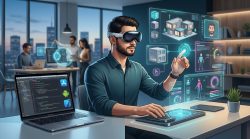
The End of "Ordinary" Apps? The IT Landscape in 2026
Just a few years ago, the peak of a mobile developer's ambition was to create a seamless iOS or Android application. However, in 2026, the mobile market has reached a saturation point, and the attention of tech giants and investors has shifted toward Spatial Computing. This is no longer just a curiosity for gamers – it is a new operating platform that redefines how we work, shop, and communicate.
At the ITcompare portal, we observe a clear trend: job offers for "Mobile Developers" are increasingly being replaced by the demand for Spatial Interaction Engineers. Why are Swift and Kotlin specialists abandoning 2D in favor of the third dimension in such high numbers?
1. The Glass Ceiling of Traditional Mobile
The mobile app market in 2026 has become a market of optimization rather than innovation. Most projects involve maintaining legacy systems or making minor UI improvements. Developers seeking challenges are hitting a "glass ceiling." At the same time, Spatial Computing offers a "Wild West" of opportunities – creating entirely new design patterns, such as Liquid Glass or interactions based on gaze tracking.
2. A Natural Tech Bridge: SwiftUI and Jetpack Compose
The transition from mobile to spatial computing is easier than it might seem. Apple visionOS and Android XR (which became the standard for AR/VR headsets in 2026) are built on foundations familiar to mobile programmers:
- SwiftUI and RealityKit: iOS developers seamlessly transition to creating windows and 3D objects within the Apple ecosystem.
- Kotlin and Unity: Android developers leverage their experience in app lifecycle management to build interactive spatial environments.
- Edge AI: Processing data locally on the device, which was crucial in mobile, has become the heart of Spatial Computing, where latency must be near zero.
3. A New Role: Spatial Interaction Engineer
What exactly is an interaction engineer? It is the evolution of the frontend and mobile developer. In 2026, their work is not about programming "clicks," but about designing Zero UI interactions. The user does not touch a screen – they look at an object and perform a pinch gesture in the air. The engineer must understand hand anatomy, the physics of light, and the principles of anchoring digital objects in physical space (spatial anchors).
4. Salaries and Market Demand
Data from the ITcompare aggregator indicates significant differences in compensation. While senior mobile salaries have stabilized, Spatial Computing specialists can expect a market premium of 20-35%. In 2026, the talent shortage in this niche is immense – for every qualified interaction engineer, there are an average of three job offers in sectors such as medicine (surgery simulations), industry (digital twins), and retail (virtual fitting rooms).
5. How to Start Your Pivot in 2026?
If you are a mobile developer and want to change your career path, 2026 is the perfect time to start. Here are specific steps:
- Master 3D frameworks: Even if you are not making games, knowledge of Unity or RealityKit is essential for manipulating objects in space.
- Understand Spatial UX: Read the Apple Human Interface Guidelines for visionOS – it is currently the "bible" of the new design.
- Track offers on ITcompare: Look for roles with tags such as Mixed Reality, Spatial UI, or XR Developer.
Summary
Spatial Computing is not just another fad, but a fundamental paradigm shift. Mobile app developers, thanks to their skills in building efficient, reactive systems, are best prepared to take on leadership roles in this new era. Transitioning to a spatial interaction engineer is the most reliable way to secure your future in IT in 2026.