
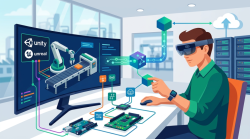
Industrial Metaverse: The End of the Hype Era, Time for Engineering
Just a few years ago, the term "metaverse" was mainly associated with virtual meetings in VR goggles and the NFT market. In 2026, this image has completely changed. The Industrial Metaverse has become the foundation of modern production, and its heart is no longer games, but Digital Twins powered by real-time data. For Backend and Embedded developers, this opens the door to one of the most profitable niches in the history of the IT sector.
Why Have Game Engines (Unity, Unreal Engine) Entered Factories?
Modern production lines generate massive amounts of data from thousands of IoT sensors. Traditional 2D dashboards are no longer sufficient for managing such complexity. Companies like BMW, Mercedes-Benz, or Siemens use game engines – primarily Unreal Engine 5 and Unity 6 – to visualize this data in a photorealistic 3D environment. This allows for:
- Process Simulation: Testing changes on the production line without stopping the machines.
- Immersive Training: Reducing employee onboarding time by 50% thanks to safe VR/AR simulations.
- Predictive Maintenance: Visually monitoring component wear based on sensor data.
The Role of the Backend Developer: Data Architect for the Digital World
In the Industrial Metaverse, Backend developers are no longer just building APIs for mobile apps. Their task is to create the "nervous system" connecting the physical factory with its digital reflection. Key challenges in 2026 include:
- Real-time Data Pipelines: Integrating with platforms like NVIDIA Omniverse or Microsoft Fabric Real-Time Intelligence to transmit millions of MQTT/AMQP messages without latency.
- Digital Twin State Management: Ensuring that what the operator sees in Vision Pro or HoloLens goggles is 100% consistent with the actual state of the machine.
- Cybersecurity: Protecting critical industrial infrastructure from man-in-the-middle attacks within the virtual environment.
Embedded and Edge Computing: Where Code Meets Metal
For Embedded engineers, the Industrial Metaverse represents a transition from simple microcontrollers to advanced Edge AI systems. In 2026, using NVIDIA Jetson modules directly at the machines has become the standard, allowing for local image and sensor data processing before sending it to the 3D engine.
Embedded specialists are responsible for low-level communication with PLCs (Programmable Logic Controllers) and implementing protocols such as OPC UA. Without their work, the game engine would be just an "empty shell" without contact with reality. It is at the intersection of C++, Rust, and real-time systems that the greatest added value is created.
Earnings and Perspectives: Why Enter This Niche?
The demand for Industrial Metaverse Engineers drastically outweighs the supply. This is a hybrid role, requiring an understanding of both distributed systems (Backend) and hardware specifics (Embedded), as well as the basics of computer graphics. According to 2026 market forecasts, specialists who can integrate IoT systems with 3D engines can expect salaries 30-40% higher than "standard" Java or C# developers.
How to Start? A Development Path for the Ambitious
If you work in Backend or Embedded, you don't need to become a 3D artist. Focus on:
- NVIDIA Omniverse: Learn the 3D collaboration platform that is becoming an industry standard.
- IoT Protocols: Master MQTT, OPC UA, and 5G/6G technologies in the context of low latency.
- C# / C++ Basics for Engines: Understand how to script interactions in Unity or Unreal Engine for receiving external data.
The Industrial Metaverse is not just another fad – it is the evolution of Industry 4.0, which needs solid engineering foundations. Looking for job offers in this dynamically growing sector? Check out the latest listings for Backend and Embedded developers on ITcompare.pl – your job offer aggregator for the entire Polish IT market.