
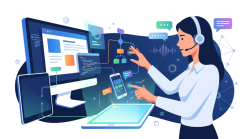
Interface Evolution: From Clicks to Intentions
In 2026, the boundary between the digital and physical worlds has almost entirely vanished. Traditional Graphical User Interfaces (GUIs), based on rectangular screens and touch, are no longer the sole standard. We are entering the era of Zero-UI and Spatial Computing, where the Multimodal Interface Engineer plays a crucial role. For Frontend and Mobile developers, this isn't just a new job title; it's a fundamental paradigm shift: moving from "building screens" to "designing spatial experiences."
Who is a Multimodal Interface Engineer?
This specialist seamlessly integrates multiple user communication channels into a single, fluid experience. Rather than being limited to handling onClick or onTouch events, this engineer designs systems that react simultaneously to:
- Voice: Using NLP (Natural Language Processing) and LLMs (Large Language Models) to understand context and intent, not just simple commands.
- Gestures: Utilizing cameras and sensors to interpret hand, body, or eye movements (eye-tracking).
- Haptics: Advanced feedback that allows users to "feel" digital objects.
- Environmental Context: Interface reactions to lighting, noise, or the presence of others.
Why is this an opportunity for Frontend and Mobile developers?
Developers who have previously built applications in React, Flutter, or Swift already possess the foundations needed to master this new field. However, in 2026, the tech stack alone is not enough. Utilizing modern APIs like the Web Speech API, Google's MediaPipe for in-browser gesture tracking, or the visionOS SDK for spatial solutions becomes essential.
In 2026, Artificial Intelligence becomes the engine driving interfaces. Generative UI allows for the dynamic creation of interface elements in real-time, adapted to whether the user is currently speaking or gesturing. The frontend developer becomes the architect of these rules, ensuring the system can "switch" between modes without losing the task context.
Key Competencies in 2026
If you are planning your career development and tracking job offers on ITcompare, you should focus on the following areas:
- Integration with Multimodal LLMs: The ability to connect frontends with models that simultaneously analyze text, images, and sound.
- Conversational Design (VUI): Understanding dialogue flow and intent mapping.
- Computer Vision on the Frontend: Basic knowledge of libraries for analyzing camera input to recognize gestures.
- Accessibility 2.0: Multimodality is the ultimate form of inclusivity – designing for users with diverse sensory needs is becoming a market standard.
The IT Job Market in 2026: Where to Find Offers?
The transformation of roles in the IT sector is evident in recruitment data. Companies in automotive (Smart Cockpits), medtech (touchless interfaces in operating rooms), and e-commerce (virtual fitting rooms) are massively searching for engineers who can think beyond the 2D box. As the market becomes more specialized, traditional job boards might not suffice to find these unique roles.
At ITcompare, we aggregate offers from multiple sources, allowing candidates to monitor the emergence of roles like "Multimodal Interaction Developer" or "Spatial UI Engineer" in real-time. This is a crucial tool for those who want to stay ahead of the competition and quickly respond to the changing requirements of employers in 2026.
Summary
Multimodal interface engineering is a natural evolution for ambitious Frontend and Mobile developers. In a world where AI takes over writing repetitive code, your greatest value lies in the ability to design interactions that are natural, intuitive, and human. The future of IT is no longer just happening on the screen – it is happening all around us.