
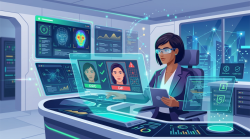
The War for Reality: A New Front in the IT Sector
In 2026, the line between what is real and what is AI-generated has almost completely blurred. According to the latest industry reports, the number of deepfake fraud incidents has increased by over 2000% in the last two years. In a world where "CEO fraud" is carried out using real-time synthetic video on Zoom or Teams platforms, the role of Deepfake Forensic Specialist has become one of the most sought-after and best-paying niches in the IT ecosystem.
Who is a Deepfake Forensic Specialist?
This role combines the competencies of a cybersecurity expert, a Data Scientist, and a digital investigator. This specialist not only detects manipulations but, above all, manages "digital truth." Their work is based on two pillars:
- Detection: Analyzing audio and video materials for generative artifacts, such as spectral inconsistencies in voice or facial micro-expressions that do not match biological patterns.
- Provenance: Implementing standards such as C2PA (Coalition for Content Provenance and Authenticity), which allow for tracking the history of a file from its creation on a device to its publication.
FinTech in the Crosshairs: Why Do Banks Pay the Most?
The financial sector has become the main battlefield. Traditional identity verification (KYC) methods based on selfies or short video recordings have ceased to be effective against "injection" attacks, where a synthetic image is injected directly into the camera stream. In 2026, financial institutions are mass-recruiting AI forensic experts to protect onboarding processes and the authorization of high-value transfers. Losses from AI fraud are estimated globally at $40 billion annually, making an investment in an elite security team a necessity rather than a luxury for banks.
Essential Skillset (2026)
If you are planning to grow in this direction, your career path should include:
1. Technical Competencies
- Proficiency in Python and knowledge of ML libraries (PyTorch, TensorFlow) for analyzing GAN networks and diffusion models.
- Knowledge of next-generation forensic tools such as Sensity, Microsoft Video Authenticator, or "liveness" biometric analysis platforms.
- Understanding of cryptography in the context of digital watermarks and X.509 certificates.
2. Certification and Domain Knowledge
Certificates confirming knowledge in digital forensics are highly valued, including GCFE (GIAC Certified Forensic Examiner) or CHFI (Computer Hacking Forensic Investigator), supplemented by specialized courses in AI Security.
Market Perspectives on ITcompare
The demand for digital truth protection specialists is growing faster than the supply of experts. At ITcompare, we observe a clear trend: job offers for "Deepfake Forensic Analysts" are appearing not only in global tech corporations but increasingly in Polish software houses working for the international banking and insurance sectors. This is a role that offers not only a "market-rate" salary but, above all, expert status in one of the most critical fields of the modern world.
Summary: Your Future in Digital Defense
A Deepfake Forensic Specialist is a profession with a mission. In 2026, these are the people guarding trust on the Internet. If you have an analytical mind and want to work at the intersection of cutting-edge artificial intelligence and cybersecurity, follow the offers in the Cybersecurity category on ITcompare. The future of IT belongs to those who can distinguish truth from a perfectly generated lie.