
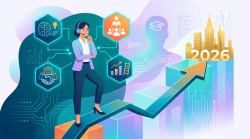
A New Era of IT Leadership: From Manager to Talent Architect
In 2026, the traditional model of managing a technology team is becoming obsolete. Today's IT market no longer needs leaders who simply assign tasks in Jira. Companies are looking for Leader 2.0 – someone who can scale the team's knowledge and competencies at the pace dictated by technological development. AI-Augmented Mentoring has become the key to this transformation.
Why now? According to market forecasts, by 2026, over 60% of IT organizations will implement autonomous systems supporting employee development. A person who can not only use them but also effectively implement them becomes an invaluable strategic asset for the employer.
What is an AI-Augmented Mentor?
It is not a robot replacing a human, but a system of connected vessels. A leader uses tools based on Agentic AI to remove the administrative burden and focus on building relationships. These systems offer:
- Intelligent matching: Algorithms analyze not only the tech stack but also personality traits and competency gaps to perfectly pair a mentor with a mentee.
- Real-time feedback: Coaching bots (e.g., advanced versions of Mentorloop or Qooper) analyze code and Slack communication, suggesting improvements and areas for learning "on the fly," without waiting for weekly 1-on-1s.
- Personalized development paths: AI dynamically adjusts the upskilling program to the employee's progress, reacting to changing market trends.
The Scalability Problem: Why Traditional Mentoring Fails?
In the classic mentoring model, the biggest barrier is time. Seniors and Leads, burdened with their own tasks, often lack the space to properly guide juniors. As a result, the onboarding process lengthens, and employee turnover increases.
Implementing AI-supported systems solves this "bottleneck." By automating repetitive elements (such as checking basic code standards or scheduling sessions), a leader can devote 100% of their time to transferring tacit knowledge – intuition, ethics, and strategic thinking, which AI will not replace for a long time.
Why is this the Shortest Path to Promotion?
If your goal is a Leader position, upper management will evaluate you through the prism of three ROI metrics that AI-Augmented Mentoring improves instantly:
- Retention: Data from 2025 shows that companies using AI-supported mentoring see 50% higher employee retention. A leader who can provide this is worth their weight in gold.
- Time-to-Productivity: Thanks to personalized AI paths, new developers reach full productivity up to 40% faster.
- Culture of Innovation: Implementing such systems proves that you are a forward-thinking leader who is not afraid of technology but knows how to harness it for human capital development.
How to Start Implementing These Systems Today?
You don't have to wait for a top-down decision from the board. As an aspiring Leader, you can start with small steps:
- Propose using AI tools to analyze competency gaps in your current team.
- Create an internal knowledge base supported by RAG (Retrieval-Augmented Generation) that will answer technical questions from junior colleagues.
- Monitor job offers on ITcompare – more and more listings for Lead/Senior positions include the ability to manage talent using modern digital tools in their requirements.
Summary
In 2026, the line between an engineer and a leader is drawn where writing code ends and designing human development systems begins. AI-Augmented Mentoring is your superpower. Mastering this skill is not just an investment in the team, but above all, the strongest argument in the conversation about your promotion.