
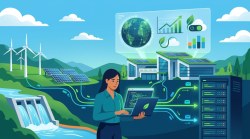
A New Era of Engineering: From Code Efficiency to Carbon Awareness
In 2026, the definition of "good code" has fundamentally changed. Just a few years ago, engineers focused primarily on latency and infrastructure costs. Today, in the face of the energy crisis and strict climate regulations, software carbon intensity has become a key metric. An Energy-Aware Software Engineer (Carbon-Aware Software Engineer) is not just a new role, but an essential set of skills for every Cloud IT specialist.
What is Carbon-Aware Software?
Energy-aware software refers to systems that can intelligently adjust their operations based on the current state of the power grid. Instead of consuming energy continuously and uncontrollably, these applications employ two main strategies:
- Temporal Shifting: Performing energy-intensive tasks (e.g., training AI models, data backups) during periods when renewable energy (wind, solar) dominates the grid.
- Spatial Shifting: Automatically migrating workloads to cloud regions that currently have the lowest carbon footprint.
Why is 2026 a Turning Point?
Several factors have caused "Green IT" to evolve from a marketing buzzword into a hard business requirement:
- CSRD Directive and Scope 3 Reporting: EU regulations (Corporate Sustainability Reporting Directive) require companies to provide detailed reports on the carbon footprint of their entire value chain, including emissions generated by IT infrastructure.
- Exponential AI Growth: Artificial intelligence models have drastically increased the demand for computing power. Without carbon-aware optimization, energy costs and emissions become growth barriers for organizations.
- Energy Price and Grid Instability: Dynamic tariffs make running processes during peak demand periods simply unprofitable.
The Engineer's Toolkit: Tools and Standards
Specialists looking for jobs via ITcompare should focus on specific technologies. Mastering the Carbon-Aware SDK created by the Green Software Foundation is crucial, as it allows for programmatically fetching carbon intensity data from APIs like Electricity Maps or WattTime. Integrating this data with CI/CD systems and platforms like Kubernetes (through projects such as Kepler) is the foundation of modern GreenOps.
How Green Skills Impact Your Career?
Analyzing job offers on ITcompare reveals a clear trend: companies in the Enterprise and Fintech sectors are increasingly seeking architects capable of designing sustainable systems. Knowledge of Green Software Engineering principles allows not only for emission reduction but also for real cloud bill savings (the synergy of FinOps and GreenOps). For an engineer, this translates to higher market value and access to the most innovative projects of 2026.
In summary, energy-aware engineering is the future of Cloud IT. It is a combination of ethics, economics, and advanced technology that defines the industry leaders of tomorrow.