
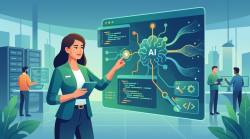
The Probabilistic Revolution: The End of the Deterministic Era in QA
For decades, the foundation of software quality was determinism: for a specific input, the system always had to return the same, predictable output. In 2026, this rule is becoming a thing of the past. With the widespread integration of LLMs (Large Language Models), agentic systems, and autonomous algorithms, the IT industry faces its biggest challenge since the birth of the internet: how to test systems that are inherently unpredictable?
QA Automation 2.0 is the answer to this shift. It is no longer just about writing scripts in Playwright or Selenium to check if a button is clickable. It is quality engineering focused on statistical correctness, algorithmic ethics, and prompt security. At ITcompare, we observe that job offers for "AI Quality Engineers" are becoming the highest-paying roles in the testing sector, overtaking traditional SDETs.
Why Traditional Automated Tests Fail Against AI?
The standard "pass/fail" approach does not work in AI systems for several reasons:
- Non-determinism: The same prompt sent to the model twice can generate two different answers. Traditional test assertions simply "crash."
- Hallucinations: A model can generate a grammatically and logically correct response that is completely false.
- Model Drift: AI performance changes over time with new data, meaning tests performed yesterday may be outdated today.
Key QA Automation 2.0 Competencies in 2026
A QA 2.0 specialist must look beyond code and enter the world of data and linguistics. Currently, the most sought-after skills include:
1. Testing RAG (Retrieval-Augmented Generation) Systems
Most business applications in 2026 are based on the RAG architecture. Testers must be able to measure metrics such as Faithfulness (is the answer based on sources?), Answer Relevancy (is the answer on topic?), and Context Recall (did the system find all the necessary information?).
2. AI Red Teaming and Prompt Security
This is a new form of penetration testing. The QA's task is to attempt to "break" the model using Prompt Injection or Jailbreaking techniques to force the system to reveal sensitive data or bypass security filters. This is a critical element in sectors such as finance or telecommunications.
3. Using Next-Generation Frameworks
The standard tech stack for an AI tester in 2026 includes tools such as:
- DeepEval: An LLM testing framework based on Pytest.
- Ragas: A specialized tool for evaluating RAG pipelines.
- Giskard: A platform for detecting bias and errors in ML models.
The Job Market: Is It Worth Re-skilling?
Analysis of offers on ITcompare shows a clear trend: demand for AI quality specialists has increased by over 120% in the last year. Companies are no longer looking for people who can "only" automate UI. They are looking for engineers who understand how model weights work, how to manage Semantic Entropy (to detect AI confabulations), and how to implement Human-in-the-loop in CI/CD processes.
Earnings in this specialization are 30-50% higher than in standard QA Automation positions. In 2026, "Quality Intelligence" is not just a buzzword – it is an insurance policy for companies implementing artificial intelligence on a massive scale.
How to Start Your Journey with QA Automation 2.0?
If you are an automation tester, your development path should include:
- Learning Python: It is the number one language in the world of AI and model testing.
- Understanding MLOps: Knowledge of how models are deployed and monitored is essential for testing them.
- Mastering Prompt Engineering: Learn to write test prompts that extract edge-case errors from models.
In 2026, the role of the tester has evolved from a "script executor" toward a "guardian of system ethics and logic." This is a fascinating time for career development in IT, and ITcompare is the perfect place to find offers that will allow you to reach this new level of professionalism.