
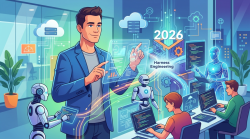
New Era of Management: From Team Leader to Lead of Agents
2026 has brought a fundamental shift in IT team structures. The traditional model, where a Team Leader managed a group of 5–8 developers, is giving way to the Lead of Agents role. In modern software houses and R&D departments, hybrid teams have become the standard, where autonomous AI agents—such as evolutions of Devin, Claude Code, or systems based on Microsoft AutoGen—work alongside humans.
For specialists tracking job offers on ITcompare, this change is a clear signal: the market is no longer just looking for managers of human potential, but for architects of "Digital Assembly Lines."
1. Orchestration instead of task delegation
In 2026, a Team Leader no longer assigns Jira tasks solely to humans. Their primary task is agent orchestration. This involves designing workflows where AI agents independently analyze repositories, write tests, and fix bugs in execution loops, while developers act as strategic reviewers and architects.
- Multi-agent systems: Managing communication between a frontend specialist agent and a tester agent.
- A2A (Agent-to-Agent) protocols: Overseeing data exchange standards between autonomous systems.
- Intent-based computing: Moving from step-by-step instructions to defining the desired business outcome.
2. Harness Engineering – the new technical foundation
A key concept dominating recruitment interviews in 2026 is Harness Engineering. This term, popularized by figures like Mitchell Hashimoto, refers to designing the "harness" for AI agents. A Lead of Agents must know how to build an environment where an autonomous agent can operate safely for hours without human supervision.
This requires proficiency in defining guardrails, managing context (Context Engineering), and implementing Governance-as-Code mechanisms that automatically block risky agent actions within cloud infrastructure.
3. Skills of the future: What must a leader know in 2026?
If you browse listings on ITcompare, you will notice that requirements for technical leaders have evolved. Key competencies now include:
- Knowledge of orchestration frameworks: Proficiency in LangGraph, CrewAI, or Semantic Kernel.
- Cognitive Load Management: The ability to balance work so that developers are not overwhelmed by the massive amount of code generated by agents.
- AI Ethics and Auditability: Responsibility for ensuring that decisions made by agents are transparent and compliant with regulations (e.g., the AI Act).
4. Psychology of the hybrid team
The leader's role in 2026 also involves caring for the well-being of the human part of the team. In a world where agents perform 80% of repetitive work, developers may feel pressure or fear of being replaced. A Lead of Agents must redefine human value in the process—emphasizing creativity, empathy toward the client, and the "aesthetic judgment" of code that AI still cannot fully emulate.
Summary: How to prepare your career?
The evolution toward Lead of Agents is a massive opportunity for ambitious IT specialists. Instead of fearing automation, it is worth becoming its architect. On the ITcompare portal, job offers for "Agentic AI Practitioners" or "AI Orchestration Leads" are appearing more frequently—it is these roles that will dictate salary terms in the coming years. The key to success is moving from writing code to designing systems that write and deploy that code autonomously.