
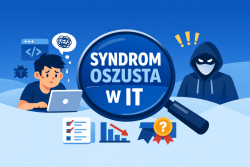
In the IT industry, the feeling of “they’re about to expose me” is surprisingly common. The paradox is that it most often affects people who objectively deliver: they learn quickly, maintain high standards, and produce visible, comparable work. At the same time, in recent years the labor market has become more selective, and many companies have raised expectations regarding autonomy and delivered impact—not just the number of commits. This creates ideal conditions for doubts about one’s competence to be mistaken for sober self-assessment.
Impostor syndrome, then, is less a “character flaw” than a predictable reaction to the environment: unclear standards, rapidly changing technologies, comparison pressure, and work that is complex, team-based, and difficult to measure.
What It Is — and What It Is Not
According to the Cleveland Clinic, impostor syndrome describes a pattern in which someone persistently feels like a fraud: they question the legitimacy of their achievements, attribute success to luck, and fear being “found out,” despite objective evidence of competence. Importantly, it is not a formal medical diagnosis.
In more technical discussions, including overviews available through NCBI Bookshelf, it is emphasized that “impostor syndrome” has no formal diagnostic criteria in classification systems. Its symptoms may overlap with anxiety, depression, burnout, or low self-esteem—which is why caution in self-diagnosis and differentiation of causes is important.
This distinction matters in market terms: if everything gets labeled “impostor syndrome,” it becomes easy to overlook real organizational problems (chaos, lack of feedback, toxic management styles) or actual mental health issues that require professional support.
The Mechanics: The “Impostor Cycle” and Why IT Amplifies It
Many descriptions converge on a recurring cycle. A high-stakes task appears (a new project, job interview, promotion, difficult incident). This is followed by either over-preparation and overwork, or procrastination driven by anxiety. Then comes temporary relief after delivery. Finally, success is attributed to luck or exceptional circumstances—without strengthening long-term self-confidence. This mechanism is often described in clinical and educational literature as a sustaining loop.
In IT, typical stimuli reinforce the cycle:
- Work is constantly “public”: code reviews, tickets, incidents, metrics, demos, backlog discussions. Even in healthy organizations, exposure is high.
- The comparison set is global. You can be an excellent engineer in your company and still feel inadequate compared to curated highlights from conferences, open source, and viral projects.
- The boundary between “I don’t know” and “I’m incompetent” easily blurs—because not knowing is normal in IT. New libraries, new models, new regulations, new outages—continuously.
What Research on Developers Shows: Scale and Inequality
Separating impressions from data is crucial. A preprint study published on arXiv examined 624 software engineers from 26 countries using the standardized Clance Impostor Phenomenon Scale (CIPS). The authors reported that 52.7% of participants experienced frequent to intense levels of impostor phenomenon. The proportion was higher among women (60.6%) than men (48.8%). Differences also appeared across racial/ethnic groups in the sample (including higher reported levels among Asian and Black participants than white participants), and the phenomenon was associated with lower self-rated productivity across several dimensions of software development work.
From a labor market perspective, this is significant: impostor syndrome is not merely “junior stage fright.” The data suggest it may affect half or more of professionals—and that it is unevenly distributed, intersecting with inclusion, barriers to entry, and the psychological costs of being a minority within a team.
Labor Market Context: Why the Topic Has Grown Louder
Impostor syndrome does not exist in a vacuum; it intensifies when uncertainty rises and standards become ambiguous. After a difficult period in 2023–2024, the Polish IT market has shown signs of recovery—but also tighter selection.
According to No Fluff Jobs, in 2025 the number of tech job offers increased by 44% year over year, alongside reduced per-offer competition in some categories and wage growth more frequently in B2B contracts. At the same time, 2023–2024 were marked by layoffs and recruitment slowdowns.
Similarly, a market summary from justjoin.it points to stabilization after declines but highlights the difficult situation of juniors: entry-level offers accounted for just 4.79% of all postings, and the market is described as “more mature,” rewarding impact and seniority. The report also notes the growing importance of data and AI/ML roles.
Globally, communications from CompTIA indicated that in mid-2025, unemployment for “tech occupations” in its analyses fell below 3% (2.8% in June), despite reductions in certain segments and overall employment volatility.
Meanwhile, trend overviews from LinkedIn continue to highlight sustained growth dynamics in AI-related roles, both technical and strategic.
Together, these signals suggest a coherent thesis: even as the market “thaws,” in many places it is less forgiving. There is less “soft landing” for beginners, and greater emphasis on autonomy, communication, responsibility, and effective use of automation tools. In such an environment, development can easily be misinterpreted as inadequacy.
Career Costs: When Impostor Syndrome Becomes More Than a Feeling
The greatest risk is not feeling down after a demo. The real risk begins when impostor syndrome starts shaping career decisions:
- Not applying for roles despite meeting most requirements.
- Not asking for a raise.
- Taking on excessive workload “to deserve” one’s position.
- Avoiding visibility (presentations, ownership).
Or conversely, compulsive overproduction leading to burnout.
Research also shows that impostor phenomenon often coexists with anxiety and depression. Some cross-sectional studies (including among students) have found significant correlations between CIPS scores and measures of depression and anxiety, with higher risk of symptoms among those with strong impostor tendencies. This does not mean impostor syndrome “causes” depression—but it signals that it should not be trivialized when accompanied by serious symptoms.
Work psychology increasingly emphasizes context: feelings of fraudulence intensify in environments with unclear standards, rare feedback, and arbitrary recognition systems. Reviews that contextualize the phenomenon suggest that framing it as an individual defect can be misleading, since organizational structures significantly modulate its intensity.
Common IT Triggers: More Systemic Than Psychological
Many “market” sources of impostor syndrome in IT are systemic rather than purely internal:
- Unclear evaluation criteria. Seniority levels are often vaguely described; promotions may appear discretionary.
- Technological volatility. Continuous learning is normal—but if culture demands being “up to date with everything,” chronic backlog feelings arise.
- Comparison to the best on the internet. Public success stories rarely show process, failure, or cost.
- Signals about automation. As generative tools accelerate parts of work, pressure grows to do more or do “more strategic” work—often without clear individual definitions.
Inequality factors also matter: being the only person from a certain gender, background, or educational path in a team can amplify self-doubt, as mistakes feel more representative.
What Helps: Individual Strategies Grounded in Work Reality
There is no single technique that “switches off” impostor syndrome. What tends to work are bundles of small interventions that reduce susceptibility to the cycle and improve feedback realism.
- Evidence over impressions. Keeping a brief log of achievements and decisions (what I delivered, what improved, what impact it had) counters memory bias in environments where work is scattered across tickets and pull requests.
- Calibrating standards. Distinguishing between “not knowing” and “being incompetent.” In IT, competence often means being able to reach an answer—not already having it.
- Gradual exposure. Avoiding presentations or ownership strengthens the cycle; sudden leaps can also amplify anxiety. Incremental steps—small demos, scoped ownership—help.
- Discussing expectations instead of emotions. Rather than “I feel inadequate,” asking, “What defines good performance in this role over three months?” shifts the focus from identity to criteria.
When symptoms intensify, professional support matters. Medical sources note that counseling and cognitive-behavioral approaches (CBT) can help address accompanying anxiety, low mood, or persistent self-criticism. A mapping review of 31 intervention studies suggests that training and counseling—especially education about the phenomenon and group-based support such as mentoring or workshops—show promise.
What Teams and Companies Can Do: The Organizational “Treatment”
If you influence team culture, reducing uncertainty and arbitrariness has the strongest effect. In practice:
- Clear criteria for levels and expectations, with behavioral examples.
- Regular, concise feedback (rarity increases speculation; speculation feeds self-doubt).
- Normalizing not knowing (when seniors openly say “I don’t know, I’ll check,” performative certainty pressure drops).
- Safe code reviews focused on code, not identity.
- Better onboarding and system maps to reduce contextual gaps.
These are not “soft” practices. In the developer study cited earlier, higher impostor phenomenon correlated with lower perceived productivity across multiple dimensions. If companies want performance, addressing this is organizational hygiene—not a coaching curiosity.
When It’s Not “Just” Impostor Syndrome
IT culture can normalize chronic stress. Red flags include:
- Persistent sleep problems, somatic anxiety symptoms, panic attacks, prolonged low mood, or anhedonia.
- Perfectionism leading to constant overwork or decision paralysis.
- Burnout or noticeable decline in functioning.
In such cases, psychological or psychotherapeutic consultation makes sense—not to label a syndrome, but to address mechanisms and possible comorbid difficulties.
Conclusion
Impostor syndrome in IT fits the industry’s conditions: high visibility, constant change, public evaluation, and a labor market that has become more demanding—especially for juniors. Research suggests it may affect over half of software engineers and is unevenly distributed across groups.
The most practical approach is dual-track: individual work on cognitive and behavioral mechanisms (evidence tracking, calibration, controlled exposure, sometimes therapy) combined with organizational conditions that reduce uncertainty and arbitrariness (clear criteria, feedback, onboarding, healthy review culture). When both tracks operate together, impostor syndrome tends to lose its fuel.