
Over the past two years, the IT labor market has received an accelerated lesson: many tasks that for decades were considered “intellectual craftsmanship” have turned out to be surprisingly vulnerable to automation. Not because programmers suddenly became unnecessary, but because a large share of their daily work is purely digital—operating on texts, schemas, interfaces, and repository artifacts. That is the natural habitat of generative AI.
In the Polish context, two figures are worth remembering. First, according to a NASK–PIB report on GenAI, around 30.3% of jobs in Poland have some degree of exposure to generative AI (approx. 5.08 million positions), and about 4.9% of workers are employed in occupations with very high susceptibility. Second, the Polish Economic Institute indicates that among the occupational groups “most exposed” to AI’s impact are professional roles, including programmers.
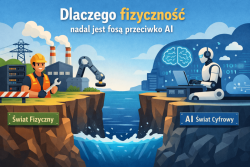
So if you are looking for a “moat”—a feature of work that is hard to copy, scale, and cheaply replace—physicality is still one of the most solid. The paradox is that AI is getting better and better at text, images, and code, yet still struggles with a world that is trivial for humans: grip, friction, messiness, safety, travel, accountability.
What “physicality” actually means in the context of work
This is not just about whether a job is “manual.” Physicality is a broader bundle of characteristics:
-
Contact with the material world: equipment, infrastructure, devices, production environments, installations, logistics.
-
High cost of error: human safety, breakdowns, material damage, downtime, legal liability.
-
Variability and unpredictability: unstructured environments, the “long tail” of exceptions, imperfect data.
-
Need for presence: someone must go there, touch, replace, measure, start up, receive, sign off.
AI scales brilliantly where the only cost is energy and computation. The physical world has friction—logistical, legal, and literal.
Why “digital” roles are hit first
Generative AI has an advantage wherever work largely consists of information processing: writing, summarizing, coding, analysis, documentation, text-based customer support. This explains why public debates so often return to themes of the “shrinking entry level” and pressure to rapidly upgrade skills.
In materials for The Future of Jobs Report 2025, the World Economic Forum describes the scale of transformation and points to seemingly contradictory but coexisting trends: some organizations expect headcount reductions in roles where skills are being rendered obsolete by AI, while many also plan to hire people with new AI-related skills.
This helps explain why simply being “in IT” is no longer automatic immunity. If your job mainly involves producing digital artifacts, you are competing with a tool that works instantly, never sleeps, and can generate thousands of variants.
Physicality as a moat: three hard mechanisms
Mechanism 1: “Moving atoms” is expensive and slow In code, the cost of replication is near zero. In the material world, every deployment has costs: hardware, integrations, servicing, training, downtime, insurance. Even if a robot can “in theory” perform a task, in practice it must do so safely, reliably, in real time and in real environments.
Mechanism 2: The long tail of exceptions kills automation Robotics and automation work best in standardized environments. Where there is disorder, diversity of objects, and changing conditions, problems grow exponentially. Review research in robotic manipulation explicitly highlights difficulties such as modeling, uncertainty, disturbances, and sensing constraints that hinder scaling solutions “in the wild.”
Mechanism 3: Responsibility and trust stick to humans In digital processes, it is easier to accept a “model mistake” because consequences are often reversible (you revert a commit, fix a ticket, ship a hotfix). In the physical world, an error may be irreversible or extremely costly. As a result, organizations are slower to grant full autonomy to machines and more often choose an arrangement where automation supports—but a human approves and remains accountable.
But robotics is accelerating. Yes—just where?
It is important to be precise: physicality is a moat, not a wall. Automation is advancing, and robotics is growing—but along specific profiles.
The International Federation of Robotics reports that in 2024 more than 401,000 industrial robots were installed in Asia, with China alone accounting for over half of global installations (54%). Meanwhile, the economic section of the AI Index Report 2025 (Stanford HAI) notes that the global operational stock of industrial robots reached 4.282 million in 2023, with the share of cobots in new installations rising in recent years.
The conclusion: robotization is growing, but most strongly where environments are structured (production lines, predictable tasks, controlled risk). This does not contradict the moat thesis—it refines it. The moat is weakest in the “geometric factory” and strongest in the “crooked world”: field service, construction, on-site logistics, critical infrastructure, highly variable environments.
How physicality reshapes the IT labor market
For some, “physicality” sounds like advice to retrain as a plumber. In IT, however, it means that the relative value of skills connecting software with the real world is rising. Here are areas where the moat is typically deeper than in pure web development:
-
Infrastructure and data centers Networks, servers, backup power, cooling, physical access, hardware replacement, on-site diagnostics. AI can assist with monitoring and incident analysis, but someone still has to execute the work on location.
-
IT/OT and industrial cyber-physical systems Integrations with PLCs, SCADA, production systems, maintenance. Errors are costly and deployments lengthy. The advantage lies in understanding how a plant operates—not just how a framework works.
-
IoT and edge computing Field devices, connectivity, firmware, power constraints, updates in harsh conditions. This is work where “you can’t simulate everything.”
-
Cybersecurity with a physical component Infrastructure security, OT segmentation, physical access control, on-site audits. Attacks and defenses often cross organizational and physical layers.
-
Deployments, integrations, the B2B “last mile” Less glamorous than building new features, but often more automation-resistant: configurations, migrations, integrating with messy legacy client systems, training, acceptance testing.
These paths do not eliminate AI from the job. They shift the proportions: generative tools help write code and documentation faster, but the core value lies in making solutions actually work in real environments.
Economics: why even “moderate” automation won’t quickly eliminate physical tasks
The McKinsey Global Institute estimates that by 2030, even in a midpoint scenario, “up to 30% of current work hours” could be automated, with GenAI accelerating the process. At the same time, it emphasizes that physical and manual skills accounted for about 30% of work hours (in its 2022 analysis), and demand for them may remain relatively stable.
This is an important counterpoint to the “AI will take everything” narrative: even with strong AI adoption, the economy will still require substantial labor tied to the physical delivery of services and goods. In IT, this means that roles bridging the digital and the physical have solid demand fundamentals.
The “social” moat: face-to-face interaction and teamwork
Part of the human advantage is not strictly manual but socially embodied. The classic task-based approach to automation (in the tradition of OECD research) notes that even in occupations considered “automatable,” there are components that are difficult to automate—such as those based on interaction and group work. “Face-to-face interactions” are explicitly cited as reducing the true level of automatability.
This translates surprisingly directly into IT: people who do not just “produce code” but also negotiate requirements, run workshops, handle production incidents, and act as the face of an implementation for the client possess advantages that cannot be easily replicated by a language model alone.
Poland: readiness to learn AI and pressure to adapt
The NASK report shows that 58.4% of working Poles declare readiness to learn AI-related skills, and in occupational groups vulnerable to automation, many respondents see AI as a chance to accelerate tasks—alongside concerns about control and declining earnings.
In practice, this means the “physicality moat” does not excuse anyone from learning AI. Rather, it suggests: learn AI as a tool, but anchor your value in the real world, where merely generating text or code does not deliver the result.
What physicality changes in an IT career strategy
The simplest pragmatic lesson: if you can choose projects, choose those with a deployment component and real-world consequences.
Some directions that often act as “moat amplifiers”:
-
Moving from a “feature factory” to roles responsible for outcomes: SRE, platform engineering, incident management, reliability, security.
-
Entering regulated, high-stakes domains: energy, manufacturing, logistics, medtech, transport, telecom. These sectors involve compliance, safety, auditability, and long decision cycles.
-
Developing integration skills: protocols, devices, monitoring, telemetry, observability, deployment automation, tools for field teams.
-
Learning to operate under constraints: latency, real-time systems, failure modes, offline operation, graceful degradation.
Paradoxically, in a world where generating code becomes easier, the value of judging risk, quality, and side effects rises. These are largely engineering skills—not literary ones.
Counterargument: “physical AI” and humanoids could eat the moat
This must be acknowledged: the most serious attempt to bypass the physicality moat comes from embodied AI and physical AI. Major players are investing in models and platforms that integrate perception, language, and action in the real world. Industry media regularly report initiatives around humanoids and AI-driven robot control.
However, even if model capabilities are growing quickly, the labor market question remains: how fast and in which environments will this translate into mass, economically viable deployment? For now, robotics scales most easily under controlled conditions, while in unstructured environments it faces the constraints highlighted in the literature (uncertainty, disturbances, sensing limits).
Therefore, over the next several years, a “human + automation” scenario is more realistic than full replacement. From a worker’s perspective, the best strategy is to build skills that position you as the person who selects, deploys, supervises, and takes responsibility for the tools.
Conclusion
Physicality still acts as a moat against AI because it imposes costs, risks, and unpredictability that cannot simply be “processed as tokens.” For the IT labor market, this means a shift in the center of gravity: away from merely producing code and toward roles that bridge software with the real world, ensuring reliability, security, and deployment far from laboratory conditions.
If someone is betting that “AI will bypass IT,” they are using the wrong map. But if they recognize that AI will become another layer of tools—and that the real advantage lies in delivering results in the physical world—then the moat not only exists. It is likely to remain (somewhat brazenly) wide for a long time to come.