
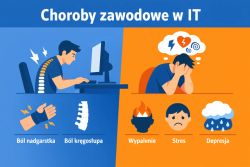
IT professionals—despite working primarily at computers—are exposed to a range of occupational diseases affecting both physical and mental health. Prolonged sitting, repetitive hand movements, monotonous tasks, deadline pressure, and isolation resulting from remote work can lead to musculoskeletal and visual disorders as well as psychological problems. This article discusses the most common conditions in the IT industry, their causes, and their consequences for productivity and the labor market, highlighting the role of prevention and employee support.
Physical Diseases
Computer-based work, although seemingly light, poses significant health challenges for IT specialists. An improper chair, incorrect monitor positioning, or a lack of breaks can lead to strain on the spine and muscles. Industry portals indicate that risk factors in the IT profession fall into four categories: ergonomic, psychosocial, biological, and accidental. For example, sedentary work (without proper ergonomics) causes chronic back and neck pain and postural disorders in the majority of employees. Task monotony and repetitive hand movements increase the risk of wrist conditions. Overall, a non-ergonomic workstation leads to overload of the back and limb muscles, which in the long term results in postural defects and degenerative spine conditions.
-
Ergonomic factors – e.g., prolonged computer work without breaks, poor chair and monitor setup, leading to overload of the spine and the shoulder and neck muscles.
-
Psychosocial factors – chronic stress, monotony, and deadline pressure; these strain mental health and may also contribute to somatic complaints (e.g., muscle tension).
-
Biological factors – working in air-conditioned offices promotes the spread of infections, weakening employees’ overall immunity.
-
Accidental factors – though less common, minor office injuries (e.g., trips or collisions with equipment) also pose health risks.
Carpal Tunnel Syndrome
Carpal tunnel syndrome is one of the most common occupational diseases among IT professionals. It involves chronic compression of the median nerve in the carpal tunnel, mainly caused by long hours of repetitive hand movements while using a keyboard and mouse. Symptoms include tingling and numbness in the thumb and fingers (especially after prolonged work), reduced grip strength, and pain radiating to the forearm. Neglected “IT wrist” can lead to permanent nerve damage and significantly impair everyday functioning.
Back Pain and Postural Defects
Long-term sitting in a non-ergonomic position most often results in chronic back and neck pain. IT professionals mainly report pain in the lumbar and cervical spine—neck muscle tension, shoulder pain, and lower back discomfort. Over time, chronic discomfort may develop into postural disorders such as increased lumbar lordosis or thoracic kyphosis. Neglecting ergonomics leads to gradual spinal degeneration—the employee experiences increasing difficulty maintaining proper posture, which affects both productivity and work comfort.
Eye Strain and Visual Impairments
Eye problems should not be overlooked. Prolonged staring at a computer screen often results in dry eye syndrome, manifested by burning, redness, and a gritty sensation in the eyes. Long-term visual focus on a monitor also contributes to the progression of existing vision defects. In practice, many IT professionals develop myopia or other ophthalmic conditions over time, further reducing performance and well-being.
Mental Health Disorders
Alongside physical issues, the IT industry struggles with growing mental health problems. The most common include burnout, chronic stress, anxiety disorders, and depression. Studies indicate that over 70% of IT workers notice symptoms of burnout, and around 10% struggle with depression. The World Health Organization warns that depression and anxiety globally result in the loss of 12 billion workdays annually (equivalent to approximately USD 1 trillion in losses). Mental health problems at work are therefore not only an individual burden—they reduce team performance and have measurable economic consequences.
Burnout
Burnout is a state of emotional and physical exhaustion resulting from chronic occupational stress. It has been included in the ICD-11 classification and has been recognized as a disease in Poland since 2022. In IT, factors contributing to burnout include long overtime hours and constant deadline pressure—employees often spend many extra hours completing projects, which over time leads to fatigue and reduced effectiveness. A burned-out programmer loses motivation, creativity, and enjoyment of work, and often begins to avoid team interactions or tasks requiring engagement.
Depression, Chronic Stress, and Anxiety
Depression and anxiety represent another burden for IT specialists. Long hours in front of a computer, feelings of isolation, and intense pressure from managers and clients all contribute to deteriorating mental health. In a Polish study, one in ten IT professionals admitted to experiencing depressive symptoms. Untreated, chronic mood disorders manifest as persistent low energy, sleep disturbances, increased irritability, and a sense of helplessness—ultimately leading to significant deterioration in work and personal life. It is worth emphasizing that burnout and depression often coexist, making early intervention in cases of sustained fatigue and mood disturbances crucial.
Risk Factors and Causes
The nature of IT work involves unique health stressors. Key causes include:
-
Prolonged sitting and overtime – programmers often work many hours on a single project, leading to chronic physical and mental fatigue. Long hours at a computer (often without regular breaks) result in back, neck, and eye pain, as well as overall exhaustion.
-
High deadline pressure – constant “deadline chasing” means projects never truly end, and employees experience continuous tension. Reports indicate that unrelenting deadlines increase mental fatigue, hinder post-work recovery, and impair concentration.
-
Isolation and remote work – while working from home has advantages, it often blends into private life. The lack of direct contact with a team fosters loneliness and loss of motivation. When the boundary between work and home disappears, employees remain perpetually “at work,” resulting in apathy and difficulty disengaging from duties.
-
Monotony and lack of development – repeatedly performing similar tasks and the pressure of continuous upskilling can be discouraging. IT professionals who feel a lack of new challenges or see no promotion prospects are more likely to lose interest in their work. The absence of a sense of professional growth intensifies frustration and contributes to burnout.
-
These factors often occur simultaneously—for example, isolated desk work frequently coincides with time pressure and task monotony, together increasing the risk of both physical and mental health issues.
Impact on Productivity and the IT Labor Market
Health problems in IT translate into tangible challenges for organizations and the labor market. High employee turnover is common—reports indicate that the average annual attrition rate in IT companies is around 23%, significantly higher than in other sectors. Burnout further amplifies this turnover—up to 52% of burned-out employees report actively seeking another job.
-
Turnover: The IT industry has a high attrition rate (approx. 23% annually), which entails continuous recruitment and costs associated with losing skilled staff.
-
Absenteeism: Work flexibility (e.g., the possibility of remote work while ill) means that official sick leave rates in IT can be relatively low. However, short-term absences (one- or two-day leave) are common. Employers’ flexible approach to sick leave may reduce recorded absenteeism, but it does not truly shorten the recovery time employees need.
-
Productivity: Chronic stress, burnout, and health issues reduce employee engagement. Globally, the “cost of burnout” is estimated at USD 438 billion annually, reflecting lost productivity due to reduced engagement and absenteeism. Industry reports also confirm that average team productivity and profitability in IT companies can be lower than in other sectors. Losses affect not only direct efficiency but also team creativity, which suffers due to illness and turnover.
Prevention and Support
To counter occupational diseases in IT, preventive actions are needed at multiple levels:
-
Workstation ergonomics – investing in adjustable desks and chairs, proper wrist supports, and correct monitor and keyboard positioning are basic protective measures. Improved desk ergonomics alone reduce muscle strain and improve productivity. Specialists also recommend vertical mice or wrist rests to reduce pressure on the median nerve.
-
Breaks and physical activity – relieving the body during the workday is crucial. Every 30–40 minutes, a short break is recommended to perform stretching exercises (e.g., wrist rotations, back or leg stretches). Movement and brief exercise help relax muscles tightened by sedentary work. Incorporating regular physical activity (exercise, walking, sports) into daily life significantly reduces the risk of spinal issues and carpal tunnel syndrome.
-
Mental health support and social prevention – companies can implement well-being programs, provide access to specialists (psychologists, coaches), and organize stress-management training. The WHO emphasizes the effectiveness of preventive workplace mental health measures (promoting a healthy lifestyle, work–life balance policies, and open communication). Unfortunately, studies suggest many IT organizations still fail to provide adequate mental health support—nearly 60% of IT professionals report that their employers do not offer mental health services. Implementing support systems (e.g., regular team meetings, coaching, anonymous consultations) is therefore essential.
-
Maintaining work–life balance – employees should set clear boundaries between work and personal time, avoid checking work email after hours, and use vacation time fully for recovery. Organizations can support healthy balance by limiting overtime and encouraging rest. Building a work culture that values rest and hobbies is just as important as equipment ergonomics.
Summary
The IT industry faces the challenge of caring comprehensively for employee health. This requires equal attention to ergonomic aspects of computer-based work and the psychological needs of teams. Preventing occupational diseases in IT involves investment in ergonomic workstations, regular breaks and physical activity, as well as mental health support and training. Employers who ensure safety and balance for their teams—through ergonomics, healthy workplace relationships, and access to psychological support—will benefit from healthier, more engaged, and more effective employees. In the long term, prevention and support lead to lower turnover, reduced absenteeism, and higher productivity—benefiting both employees and the IT labor market as a whole.